B–03Business
ChatGPT for Architecture Proposals and RFP Responses
On this page
- What can ChatGPT do in a proposal?
- The 6-step workflow from RFP to submitted response
- Five prompts that survived a real test
- Can ChatGPT write the whole architecture proposal?
- Is it safe to paste an RFP into ChatGPT?
- Which ChatGPT plan fits proposal work?
- What you can do for free
- Do you have to disclose AI use in a bid?
- FAQ
- Sources
ChatGPT works as an assembly tool for architecture proposals and RFP responses - it extracts the RFP’s requirements into a compliance matrix, writes first drafts of approach sections from facts you supply and tailors boilerplate to a new client - while the strategy, the fee and every claim of fact stay yours. Expect roughly the first 20 percent of a usable document, the working figure of a practitioner who runs RFP responses through ChatGPT (Landscape Architecture Magazine, April 2026), and expect it to invent qualifications wherever you leave a gap.
Architecture proposals are the obvious place to try ChatGPT because they are unpaid work that takes up the evening. The RIBA AI Report 2026 says: “In business development, winning work is becoming increasingly challenging. Many companies spend significant amounts of time on non-fee-earning work, such as proposals, credential packs and tender responses.” (RIBA AI Report 2026, August 2026; survey March-April 2026, more than 1,100 respondents, UK-weighted.) On the US side, 63.2% of the 535 AEC marketing professionals surveyed by OpenAsset in October 2024 said more than half of their team’s time goes to proposals.
What follows comes from the documents I read and five prompts I tested. Each prompt was run once against GPT-6 Astra, run programmatically from a command-line client, on 21 October 2026, on synthetic fixtures - a fictional municipal library RFP and a fictional 11-person firm written for the test, no live client data. These were single runs, so treat my findings as qualitative observations.
What can ChatGPT do in a proposal?
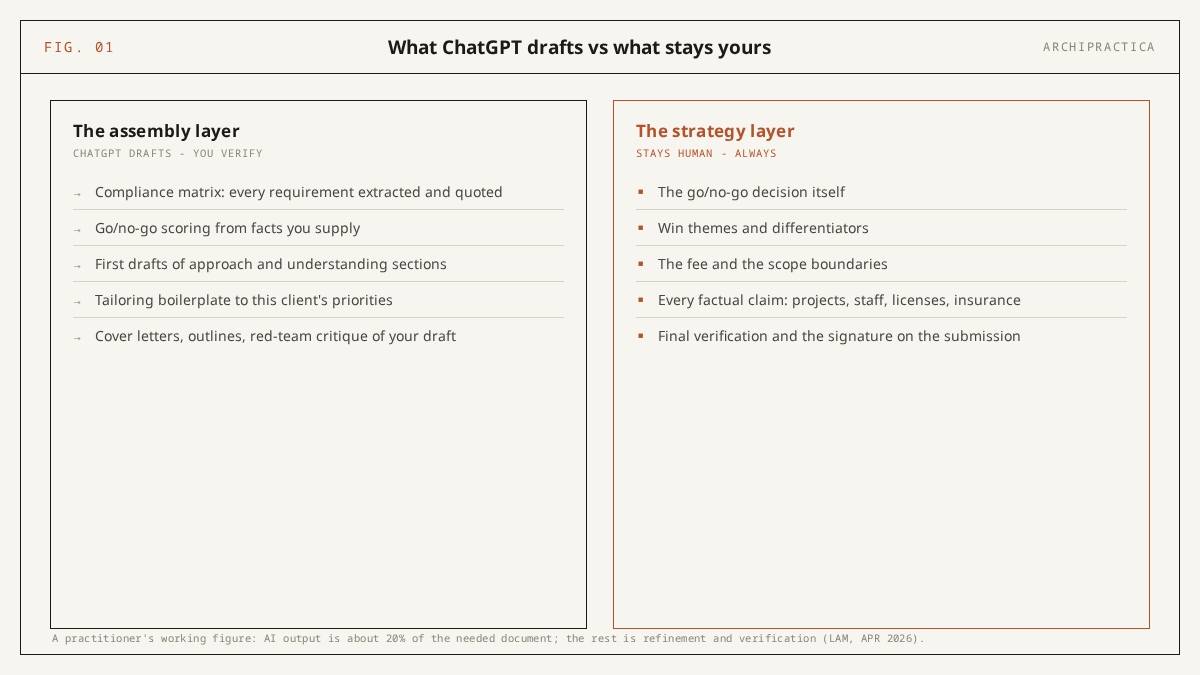
ChatGPT handles the assembly layer of an architecture proposal. It turns the RFP’s requirements into a compliance matrix, scores a go/no-go against facts you give it, drafts an approach section from your project list, re-orders boilerplate around a new client’s priorities and writes the cover letter. The decision to bid, the win themes, the fee and every factual claim remain human work, and ChatGPT fills any gap you leave with plausible invention.
The RIBA report describes AI generating first drafts of fee proposals with outline and methodology sections from the practice’s own templates, and converting historical bids into searchable content so related case studies can be recommended and responses aligned with evaluation criteria (RIBA AI Report 2026, August 2026). Every item on that list involves arranging material the practice already has.
Proposal managers in government-contracting communities describe the same split, with ChatGPT and similar tools used for first drafts, compliance matrices and RFP breakdowns, strategy and win themes kept in human hands, and a warning that unguided output quickly sounds generic (r/govcon thread, 2026). The table below shows how I divide the work.
| Assembly layer (ChatGPT drafts) | Strategy layer (stays yours) |
|---|---|
| Compliance matrix from the RFP text | Go/no-go decision itself |
| Go/no-go scoring against facts you supply | Win themes and differentiators |
| First draft of understanding and approach sections | Fee, scope and stage structure |
| Tailoring of boilerplate to the client’s priorities | Every claim of fact: projects, staff, licenses, certifications |
| Cover letter and transmittal drafts | Final verification and signature |
| Red-team critique of a draft against scoring criteria | Decision on what the critique means |
The 6-step workflow from RFP to submitted response
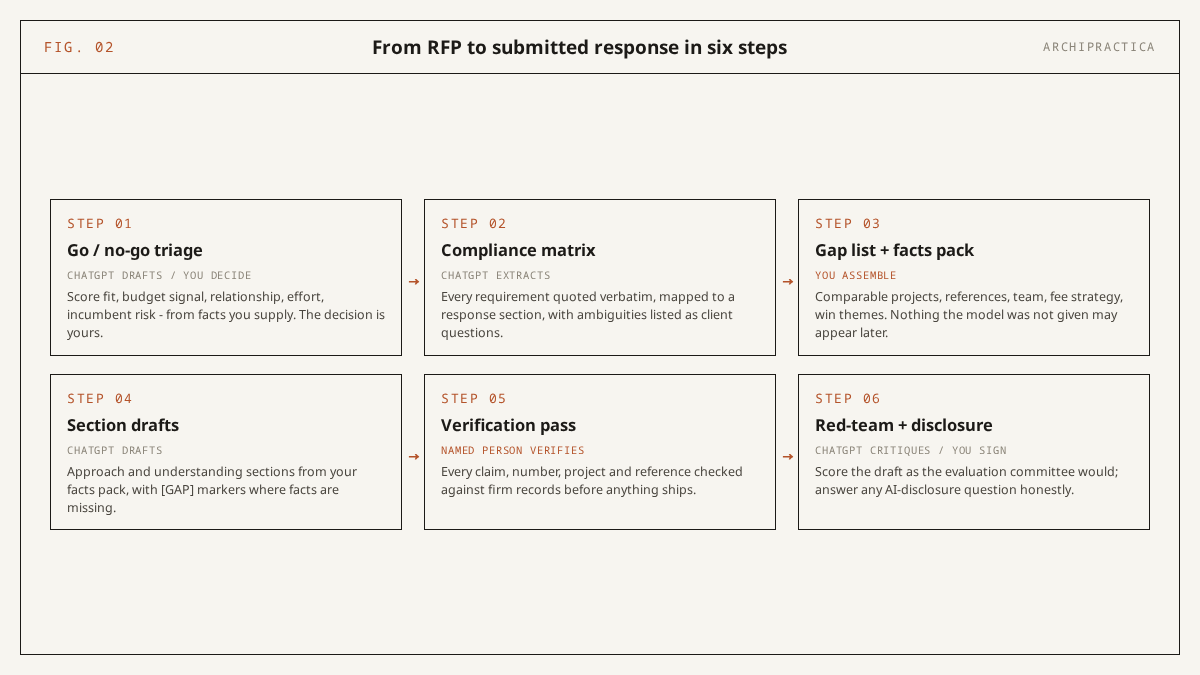
My workflow for an architecture proposal runs in six steps, and ChatGPT touches four of them. I triage the opportunity, extract the requirements into a matrix, build a gap list and a facts pack from firm records, draft sections from that pack, verify every claim against the records, then red-team the draft and check the RFP’s disclosure terms. The verification pass is the one step I never shorten.
In the QorusDocs 10th Annual Proposal Management Survey (297 professionals, AEC 20% of the sample, February 2026), 47% of AEC respondents handle 5-9 proposals a month, 49% say an average request takes 6-10 days, 74% involve 11 or more contributors and 44% cannot complete 20-29% of incoming RFPs for lack of capacity. That sample covers organizations of 100 to 5,000+ employees, far larger than a typical studio with fewer hands and the same deadlines.
- Go/no-go triage. Before anyone reads the full RFP, I paste a summary and a short firm profile into prompt P2 and ask it to score the opportunity as a skeptical principal. The point is to decline early because an RFP response you should not have started costs more evenings than any prompt saves.
- Compliance matrix. Prompt P1 reads the full RFP text and returns a numbered table of requirements in the client’s exact wording, the response section that answers each requirement, whether it is mandatory or scored, and the evidence to attach. Submission formalities go in the same table, since a missed form loses a bid before anyone reads the approach. I check the matrix against the RFP before it becomes the outline.
- Gap list and facts pack. Working from the matrix, I list which projects, staff, licenses, insurance certificates and references the RFP response needs and pull each one from firm records into a short facts pack. Anything missing goes on a gap list with a named owner. This step has no prompt because the model cannot know what the firm has done.
- Section drafts. Prompt P3 drafts the understanding and approach section from the facts pack and the RFP excerpt, and prompt P4 re-orders an existing boilerplate section around the new client’s priorities. Both prompts tell ChatGPT to flag every gap with a marker and leave it empty. I draft one section at a time, tied to the requirements it must answer.
- Verification pass. A named person reads every factual sentence in the draft and checks it against the firm records. Project names, dates, contract values, staff titles, license numbers and certifications are the usual failure points. Nothing goes to layout until this pass is signed off.
- Red-team and disclosure check. Prompt P5 plays the evaluation committee and scores the draft against the RFP’s own criteria, quoting the weakest sentences. In the same sitting, I re-read the RFP’s confidentiality and AI-use clauses and decide whether the submission should disclose AI assistance, and then the principal signs.
Five prompts that survived a real test
These are the five prompts I would paste into ChatGPT for an architecture proposal, in the order the workflow uses them. Each was run once, so the notes below describe one output on a clean synthetic RFP, and your own run will differ in the details. The placeholders in square brackets are yours to fill, and the quality of the output depends on the quality of what you put in them.
Tested: 21 October 2026, GPT-6 Astra, five prompts, one run each, run programmatically from a command-line client, synthetic fixtures (a fictional municipal library RFP and a fictional 11-person firm), no live client data. The tests did not run inside the chatgpt.com app, and I did not re-run them on the Free or Plus models; GPT-6 Astra is the model OpenAI’s pricing page ties to the Pro plan, so expect different output on the lower tiers. For an overview of these use cases across the profession, see how architects actually use AI.
P1 - RFP compliance matrix
Use when: you have the full RFP text and need the requirements list, the submission formalities and the open questions before you plan the architecture proposal.
Read the RFP below. Build a compliance matrix as a numbered table with these
columns: requirement (quote the RFP's exact wording), section of our response
that must answer it, mandatory or scored, and what evidence we need to attach.
Include every submission formality: deadline, delivery method, page limits,
required forms, insurance certificates, license numbers. Do not paraphrase
requirements - quote them. If anything is ambiguous or missing from the RFP,
list it under "Questions for the client" instead of guessing.

[paste the full RFP text]
In my single run on the fictional library RFP, ChatGPT returned a 23-row matrix quoting the exact wording for each requirement, mapped every row to a response section and to mandatory or scored status, and caught the planted conflict between a “single PDF via the portal” instruction and a separate sealed fee PDF, raising it as the first client question. It listed 16 questions for the client where the RFP was silent. Verify every row against the RFP anyway, and the deadline and delivery method twice.
P2 - Go/no-go triage
Use when: an RFP has landed and you want a structured argument for or against pursuing it before the team spends a day on it.
Act as a skeptical practice principal. Below are an RFP summary and our firm
profile. Score this opportunity 1-5 on each: fit with our built experience,
realistic budget signal, relationship with the client (none / warm / existing),
submission effort for the stated deadline, and probability a local or
incumbent firm is favored. Justify each score in one sentence using only the
facts given. Do not invent facts about our firm or the client. End with a
one-line recommendation: pursue, pursue with conditions, or decline - and the
single strongest reason.

Firm profile: [3-5 lines: size, sectors, comparable projects, location]
RFP summary: [paste or summarize the RFP]
My run scored the five criteria with one-sentence justifications from the facts given, noted that the fictional firm had not led a library project, placed the stated budget between two of the firm’s comparable project values, and flagged that only one of three required references was confirmed. It said “pursue with conditions” and named two pre-conditions. The model labeled the favoritism score uncertain; treat it as a guess.
P3 - Project understanding and approach draft
Use when: you have assembled the facts pack and need a first draft of the section evaluators read most closely.
Draft the "Project Understanding and Approach" section of an architecture
proposal, 350-450 words. Use ONLY the facts below - if something important is
missing, insert [GAP: what is missing] instead of inventing it. Mirror the
client's own vocabulary from the RFP excerpt. Structure: what the client is
trying to achieve, the two or three hardest problems in this project, and how
our process addresses each in sequence. Plain professional language, no
superlatives, no "world-class", no "state-of-the-art".

Client and project facts: [paste RFP excerpt or summary]
Our relevant experience: [2-4 comparable projects, one line each]
Our process: [your stage structure, one line per stage]
The single run produced about 400 words of architecture proposal prose that mirrored the RFP’s vocabulary, used only the three comparable projects supplied, and inserted six [GAP: …] markers for missing information such as existing-condition documentation, cost-estimating responsibilities and the LEED certification question. Each gap marker is a to-do for a human with access to firm records.
P4 - Boilerplate tailoring pass
Use when: a standard section from a past architecture proposal is sound but speaks to the wrong client.
Below is a standard section from our past proposals and the priorities of a
new client. Rewrite the section so it speaks to this client's priorities:
reorder points so their top concern comes first, replace generic examples
with the relevant ones from the list I give you, and cut anything that does
not serve this client. Keep every factual claim exactly as written - do not
add projects, numbers, or capabilities. Keep it under [N] words.

Our standard section: [paste]
This client's priorities: [2-4 bullets from the RFP or your calls]
Relevant examples to use: [projects from your portfolio, one line each]
In my run, the model moved the client’s top priority to the front, placed budget tracking second, pushed generic peer-review material to the end, kept every factual claim as written and cut one example that did not serve the stated priorities. It compressed the section to 113 words under a 220-word cap, so if you want fuller prose, state a range such as “between 180 and 220 words”. Compare the output and the original line by line to confirm nothing factual was added.
P5 - Red-team review before submission
Use when: the draft is complete and you want an evaluator’s assessment before the client reviews it.
You are the client's evaluation committee. Below are the scoring criteria
from the RFP and our draft response section. Score our draft against each
criterion as the committee would: where does it answer the criterion
directly, where is it generic, and where does it claim something without
evidence? Quote the weakest sentences. Then list the three changes that
would most improve the score. Do not rewrite the section - critique it.

Scoring criteria: [paste from the RFP]
Our draft: [paste the section]
My run scored an intentionally weak draft 11 out of 30 on the approach criterion, labeled the score provisional because the RFP gave no scoring descriptors, and quoted the weakest sentences verbatim, including “world-class facility” and a line about libraries being vital community anchors. It returned exactly three prioritized changes and did not rewrite anything. The critique is only as good as the criteria you paste, so paste them in full.
Can ChatGPT write the whole architecture proposal?
No. ChatGPT can produce a first draft of the assembly parts of an architecture proposal, and in my tests it did that well when given facts and told to mark gaps. It cannot supply win themes, a fee, a stage structure or any fact about your firm, and evaluators reading a stack of RFP responses recognize unedited model prose. The practitioner figure I trust is about 20 percent of the document (April 2026).
The figure comes from John Payne, ASLA, a partner at SiteWorks, a 14-employee landscape architecture firm, on ChatGPT for RFP responses: “The result likely generates about 20 percent of the needed document and still requires a lot of refinement, including likely altering 80 percent of the text [that the] AI generated, fleshing out ideas, personalizing it, and better focusing it.” (Landscape Architecture Magazine, April 22, 2026.) Landscape architecture is a different profession and the RFP genre is the same, so I take the number as a fair working estimate for a practice of similar size.
Evaluators notice when that 80 percent of refinement was skipped. A poster in r/1102, the US federal contracting officers’ forum, described proposals in which AI use was obvious and the vendor had not understood the requirement (r/1102 thread, 2025). Prompt P5 exists to catch that failure before the client does.
In the QorusDocs survey (297 professionals, AEC 20% of the sample, organizations of 100 to 5,000+ employees, larger than most studios), 67% of AEC organizations report that AI handles less than half of their proposal process as of February 2026. Loopio’s cross-industry data from 1,500+ companies puts the average time per RFP response at 33 hours (March 2026). Nothing in those datasets suggests whole proposals are going out written by a model.
Important. A proposal is a representation to a client or a public agency. A certification you do not hold, a project you did not deliver or a staff bio that overstates a license can disqualify the bid or worse, and the AIA’s guidance is explicit that “Architects remain accountable for all work products, decisions, and representations made to clients, agencies, and the public”, including work produced with AI assistance. (AIA Guidance for the Responsible Use of AI, updated October 22, 2025.) In my workflow a named person verifies every factual claim against firm records before submission.
Is it safe to paste an RFP into ChatGPT?
It depends on the plan and on the RFP. Consumer ChatGPT plans train on your conversations by default unless you opt out, while Business and Enterprise workspaces do not train by default. On public-sector RFPs the sensitive material is often your own fee strategy, references and internal information as much as the client’s. Read the RFP’s confidentiality terms, anonymize where the plan or NDA requires it, and prefer a workspace plan for architecture proposal work.
Confidentiality. On the consumer plans (Free, Go, Plus and Pro) OpenAI uses your content to train its models by default; you can switch this off under Settings > Data controls (OpenAI help center, read 20 October 2026). On ChatGPT Business and Enterprise, OpenAI states that it does not train its models on your data by default, admins control retention and deleted conversations are removed within 30 days (OpenAI enterprise privacy page, updated January 8, 2026, read 20 October 2026). The AIA’s guidance for firms is one line long on this point: “Do not upload confidential client or firm data into unvetted AI systems.” (AIA Guidance for the Responsible Use of AI, updated October 22, 2025.)
Four practical rules cover most cases I encounter. First, read the RFP’s confidentiality clause and any statement about AI or third-party tools before pasting anything, because some private clients forbid sharing the document at all. Second, when the plan trains by default or the NDA is strict, replace the client name, site address, contact names and budget figures with placeholders and restore them in the final document. Third, keep your fee strategy and reference contacts out of the model entirely; they are the part of the RFP response competitors would most like to read.
Fourth, if architecture proposals are a regular part of your practice, put them in a workspace plan with training off and retention set by an admin, and write the rule down in an AI policy for your firm. The AIA Code of Ethics already requires confidentiality of client information under Rule 3.401. Public-sector RFPs are usually published, so the risk that remains is mostly yours.
Which ChatGPT plan fits proposal work?
For occasional RFP responses on public documents, Free or Plus does the job, and Plus adds Projects to keep one RFP’s files together. For regular architecture proposal work, or any RFP under an NDA, I would use a Business workspace, because it does not train on your content by default and gives an admin control over retention. Prices and limits below were read on OpenAI’s pricing page on 21 October 2026 and change without notice.
| Criterion | Free | Go | Plus | Pro |
|---|---|---|---|---|
| Price | $0 | $8/month, may include ads | $20/month | From $100/month, three usage tiers |
| Models | Everyday chat, unlimited text chats subject to abuse guardrails | Everyday chat, more messages with tools | Advanced reasoning models with GPT-6 | Pro reasoning powered by GPT-6 Astra |
| Uploads and files | Limited, 3 uploads a day; 512 MB per file, text files up to 2M tokens | More uploads, no figure published | Expanded uploads, same per-file limits | Listed as yes, no figure published |
| Projects and tasks | Listed as a Plus addition | Listed as a Plus addition | Projects, scheduled tasks and custom GPTs | Expanded projects, tasks and custom GPTs |
| Deep research | Limited | Limited | Expanded | Maximum |
| Training on your content by default | Yes, opt out in Settings > Data controls | Yes, opt out in Settings > Data controls | Yes, opt out in Settings > Data controls | Yes, opt out in Settings > Data controls |
| Who it fits | Trying the prompts on a public RFP | Budget tier; check limits before relying on it | A sole practitioner running a few RFP responses a year | Heavy reasoning use, and the model my tests ran on |
ChatGPT Business starts from 2 users, is priced per user per month, does not train on your content by default and gives workspace admins control over retention (OpenAI enterprise privacy page, updated January 8, 2026; pricing page read 21 October 2026).
Feature comparison compiled from OpenAI’s pricing page (read 21 October 2026) and help pages (read 20 October 2026). I did not benchmark the plans myself.
What you can do for free
The Free plan is enough to run most of this workflow on a public RFP, and it is the cheapest way to find out whether ChatGPT fits your architecture proposal routine at all. It gives unlimited everyday text chats subject to abuse guardrails, 3 file uploads a day, 512 MB per file and text files up to 2M tokens (OpenAI help center, read 20 October 2026).
That covers compliance-matrix and go/no-go prompts on a pasted RFP, red-team review of one section and cover-letter drafts. A season of RFPs with many attachments needs more.
Pasting text is the way around most free limits, since prompts P1, P2 and P5 work on pasted text with no upload and prompts P3 and P4 need only your facts pack and a boilerplate section. The Free plan is limited by volume and teamwork. Three uploads a day will not get through a long document pack, and there is no shared workspace for a second person to pick up the draft. Training on content is on by default until you switch it off, so keep client-identifying detail out of the free tier even on public RFPs.
Do you have to disclose AI use in a bid?
Sometimes, and you should be ready to. UK central-government buyers may ask suppliers to disclose AI use in tender creation under PPN 017, and the AIA’s guidance asks firms to disclose to clients and stakeholders when and how AI is used. No rule I have found prohibits using ChatGPT on an architecture proposal or RFP response. Read the RFP, answer any disclosure question plainly and treat the tool as you would a hired bid writer.
PPN 017, published by the UK Cabinet Office on 17 February 2025, states that suppliers’ use of AI “is not prohibited during the commercial process but steps should be taken to understand the risks associated with the use of AI tools in this context, as would be the case if a bid writer has been used by the supplier.” (PPN 017, gov.uk, 17 February 2025.) Its Annex B gives buyers example disclosure questions, marked for information only and not scored, and the note warns that model-generated content may include plausible statements, facts or references that are false. Buyers may add due diligence such as site visits, clarification questions and supplier presentations, and a presentation exposes a generic approach quickly.
On the US side the AIA frames disclosure as a professional obligation (AIA Guidance for the Responsible Use of AI, updated October 22, 2025), so a short, truthful line about drafting assistance costs nothing. How your firm words that line belongs in an AI policy for your firm.
FAQ
Can ChatGPT write an RFP response for an architecture firm?
Yes for the assembly work of an architecture proposal: ChatGPT can turn an RFP into a compliance matrix, draft an understanding and approach section from facts you supply, re-order boilerplate for a new client and critique a draft against the scoring criteria. The decision to bid, the win themes, the fee and every factual claim about your firm stay with you, and a named person verifies the facts before submission.
Will evaluators know I used ChatGPT?
If the output goes out unedited, often yes. A poster in r/1102, the US federal contracting officers’ forum, described proposals in which AI use was obvious because the text showed no understanding of the requirement (r/1102 thread, 2025). UK public buyers may also ask directly under PPN 017. Edited drafts that answer specific requirements with your own projects read as yours.
Is it confidential to put an RFP into ChatGPT?
It depends on the plan. Consumer plans (Free, Go, Plus and Pro) use your content for training by default, with an opt-out under Settings > Data controls (OpenAI help center, read 20 October 2026). Business and Enterprise do not train by default and admins control retention (OpenAI enterprise privacy page, updated January 8, 2026). Check the RFP’s confidentiality terms and anonymize when in doubt.
Does using AI on proposals violate architect ethics rules?
No rule bans it. The AIA’s guidance asks architects to remain accountable for all work products including AI-assisted ones, to keep confidential client and firm data out of unvetted systems and to disclose to clients when and how AI is used (AIA Guidance for the Responsible Use of AI, updated October 22, 2025). Check your own jurisdiction’s rules and the client contract, since both can add conditions.
What is the best AI for architecture proposals?
This guide covers ChatGPT because the prompts were tested on it and because its plan structure decides the confidentiality question for most small practices. Other models handle the same assembly tasks, and the right choice depends on the plan terms you can accept and the tasks you run most. For a side-by-side comparison on architecture tasks, see Claude vs ChatGPT on 12 real architecture tasks.
Sources
- RIBA AI Report 2026 (PDF, riba.org, August 2026; survey March-April 2026, more than 1,100 respondents, UK-weighted)
- AIA Guidance for the Responsible Use of AI by Architecture and Design Firms (PDF, aia.org, updated October 22, 2025)
- UK Cabinet Office PPN 017: Improving transparency of AI use in procurement (gov.uk, February 17, 2025)
- OpenAsset, 2024 State of Proposals in AEC Marketing (PDF report, 535 AEC marketing professionals, October 2024)
- QorusDocs 10th Annual Proposal Management Survey press release (qorusdocs.com, February 25, 2026; 297 professionals, AEC 20% of sample)
- QorusDocs, Top AEC proposal management trends from the 2026 survey (qorusdocs.com, 2026)
- Loopio, RFP statistics and win rates (loopio.com, March 26, 2026; 1,500+ companies, cross-industry)
- Landscape Architecture Magazine, “Your Mileage May Vary” (April 22, 2026)
- OpenAI, ChatGPT pricing (read 21 October 2026)
- OpenAI, Enterprise privacy (updated January 8, 2026, read 20 October 2026)
- OpenAI help center, How your data is used to improve model performance (read 20 October 2026)
- OpenAI help center, File uploads FAQ (read 20 October 2026)
- r/govcon, “Anyone here using AI for proposal/bid writing?” (community thread, 2026, paraphrased)
- r/1102, “AI use for proposals” (community thread, 2025, paraphrased)
When the next architecture proposal request lands, run prompt P2 on it before anyone reads the full document; a decline at that stage costs ten minutes and a pursued bad fit costs a week of evenings. One tested workflow per email, written for architects who do their own proposals after hours. Subscribe