T–01Tool test
Claude vs ChatGPT for Architects: 12 Real Tasks, Not Benchmarks
On this page
- How did we run the test - and what can it not tell you?
- The 12 tasks: results at a glance
- Where did Claude pull ahead? Long-document judgment
- Where did ChatGPT pull ahead? Instruction limits and checkable citations
- The six ties - and what they say about paying twice
- What we did not test: the chat-app feature gap
- Plans and prices in October 2026
- What you can do for free
- Where both tools will hurt you
- FAQ
- Sources
In our 12-task test of Claude vs ChatGPT for architects, Claude produced deeper work on tasks requiring judgment across long documents - brief audits, RFP risk reviews, outline specs - while ChatGPT (GPT-6 Astra) followed instruction limits more precisely and provided more accurate, verifiable citations. Six of the twelve tasks ended even. For most practices, the answer is to split the work: choose by task type, run the free tier of one alongside a paid plan of the other, and trust neither with anything jurisdiction-sensitive.
On 18 October 2026 we ran the same 12 tasks from a working week through both model families and compared the transcripts line by line: a client brief with planted contradictions, an RFP with a nasty indemnification clause, an IBC egress lookup, meeting minutes, a fee proposal structure, area arithmetic and more. This article reports what came back, which product and plan each result maps to, and what we could not test. It does not cover rendering tools, Revit plugins or agentic coding.
How did we run the test - and what can it not tell you?
Each of the 12 tasks went to both model families on 18 October 2026 through API access: the Claude side ran on Anthropic’s current Sonnet-tier model, the ChatGPT side on OpenAI’s GPT-6 Astra. Both models received the same prompt for each task, most with a prepared test document containing errors we knew about in advance. We scored single runs against known answers; treat this as a working comparison with no statistical weight.
Three method notes before the results, because they change how much you should trust each finding.
- We tested the models, and the apps add their own differences. Per Anthropic’s model overview (checked 18 October 2026), the current Claude lineup is Fable 5.1, Opus 5.5, Sonnet 5.5 and Haiku 5.5; we ran the Sonnet family, the tier included on every Claude plan including Free. Per OpenAI’s GPT-6 announcement (7 October 2026), ChatGPT’s chat tab runs GPT-6 Sol on Plus and above, and GPT-6 Luna on Free and Go. GPT-6 Astra powers the Pro reasoning option; our GPT runs used Astra, so treat the GPT column as a ceiling for what a $20 Plus chat returns.
- The GPT runs had web search available and used it on three tasks (the code lookup, the fee structure and the contract clause review), citing live URLs; the Claude runs answered from model knowledge. That access difference favours ChatGPT on citation accuracy and mirrors how the shipped products behave, so we kept it and disclose it.
- One run proves little. Where we say a model “won” a task, we mean it produced the better transcript that day using test material we controlled. Where results were level, we say so.
All 24 transcripts came back complete, and the task set and full outputs are dated and stored in our test archive. The 12 tasks: brief audit, RFP go/no-go, design statement with gap-marking, IBC egress lookup, CSI outline spec, drawing-vs-spec consistency check, client delay email, meeting minutes, fee proposal structure, area program arithmetic, plain-language client explanation, and an indemnification clause review.
The 12 tasks: results at a glance
Claude edged ahead on three tasks, ChatGPT on three, and six were even - neither won across the board. Claude’s wins cluster in open-ended professional judgment; ChatGPT’s wins cluster in rule-following and checkable references. The table names the task, what we checked, and the verdict, so you can match it against your own week before trusting any row.
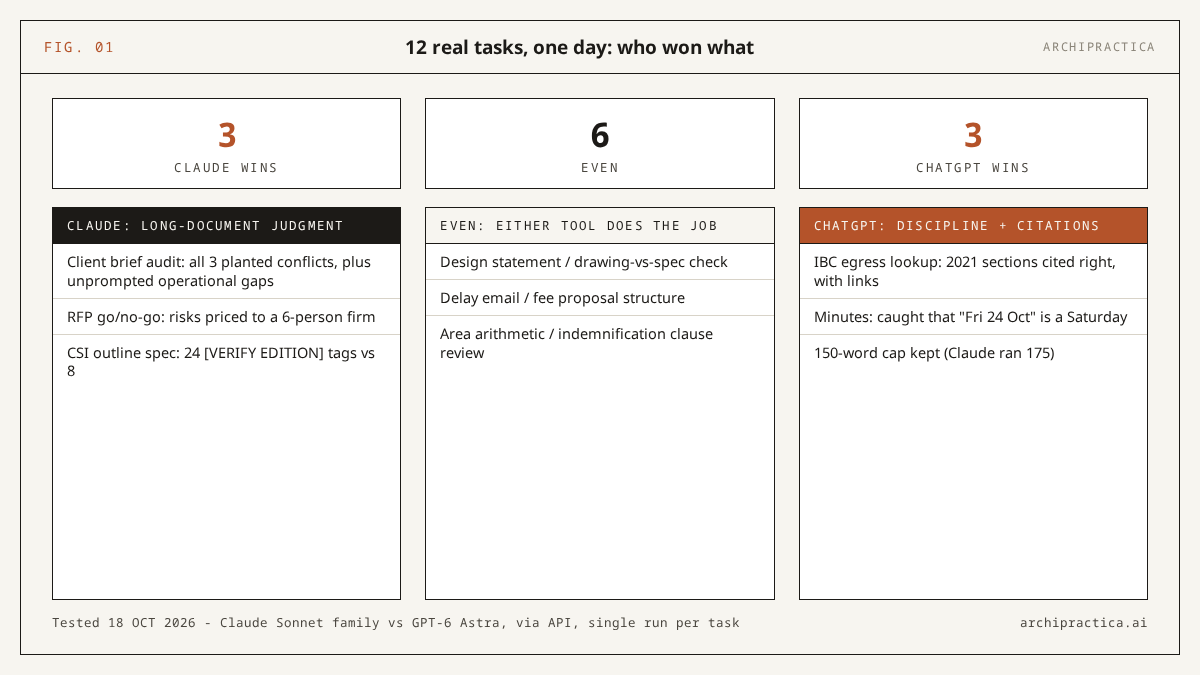
| # | Task | What we checked | Claude (Sonnet, API) | ChatGPT (GPT-6 Astra, API) | Verdict |
|---|---|---|---|---|---|
| 1 | Client brief audit | 3 planted conflicts (area, budget, parking) | All 3 found, parking math right, plus operational gaps the fixture did not plant | All 3 found, arithmetic right, stricter verbatim quoting | Claude, narrowly |
| 2 | RFP go/no-go | Uncapped liability, free interview work, fit for a 6-person firm | Caught everything and priced it to firm size | Caught everything, advised counsel review | Claude, narrowly |
| 3 | Design statement, 400-word cap | Required topics, no invention | 256 words, all topics, gaps marked [NEEDS INPUT] | 148 words, same discipline, thinner narrative | Even |
| 4 | IBC 2021 egress lookup | 3 values + exact section numbers | Values right; corridor-width section cited by the 2018 numbering | Values right, 2021 sections right, exceptions noted, sources linked | ChatGPT |
| 5 | CSI outline spec 08 11 13 | 3-part structure, standards flagged, no invented products | Full reference list, 24 [VERIFY EDITION] tags | Correct and compact, 8 tags | Claude |
| 6 | Drawing vs spec check | 5 planted contradictions + 1 dead reference | 6 of 6, zero false positives | 6 of 6, zero false positives | Even |
| 7 | Client delay email | Structure, tone, 250-word cap | 191 words, plan-first, clean | 178 words, plan-first, proposed a meeting date | Even |
| 8 | Meeting minutes from raw notes | Accuracy, TBC discipline | Clean minutes, TBC where data missing | Same, and caught that “Fri 24 Oct” is a Saturday in 2026 | ChatGPT |
| 9 | Fee proposal structure | No fee benchmarks quoted | Complied, most exhaustive checklist | Complied, cited AIA phase definitions | Even |
| 10 | Area program arithmetic | 5 calculations | All exact (549 net, 741.15 gross, 21.15 over, cut 15.67, 74.1%) | All exact, identical numbers | Even |
| 11 | Client explanation, 150-word cap | Plain language, word limit | 175 words - over the cap | 126 words, within cap | ChatGPT |
| 12 | Indemnification clause review | Risk spotting, no legal-advice framing | Defend-vs-indemnify, insurability gap, no cap, one-way clause | Same coverage plus linked AIA and ABA references | Even |
Tested: 18 October 2026, versions: Claude Sonnet family and GPT-6 Astra, both via API, single run per task. Chat-app results on other plans will differ.
Where did Claude pull ahead? Long-document judgment
Claude won where the document was open-ended, there was no single right answer, and value was measured by what the reviewer notices. On the brief audit it found every planted conflict and then kept going - it questioned how a hall could be “independently lettable in the evenings” with one shared lobby, and checked whether 16 months from planning submission to opening was plausible, none of it requested by the prompt.
The brief fixture planted three contradictions: a room schedule totalling 912 m2 inside a stated 850 m2 gross floor area, a 2.1 million euro budget against a 1.8 million financing ceiling, and 12 proposed parking spaces where the quoted zoning ratio demands 17. Both models caught all three and did the arithmetic correctly. Claude’s transcript read like a senior colleague’s margin notes; ChatGPT’s read like a careful paralegal’s extraction, with every quote cited and calculated figures explicitly separated from brief requirements. Both styles are useful, and for a go/no-go meeting I would bring Claude’s.
The same pattern held on the RFP review, where Claude flagged the uncapped liability clause, the unpaid interview design concept and the insurance floor, then weighed each against a six-person firm’s capacity. On the outline spec, Claude produced three times as many flagged reference standards as ChatGPT ([VERIFY EDITION] tags on every one, as instructed) and a fuller related-sections list. Neither model invented product numbers. This matches what we found writing our Claude guide: brief and RFP analysis is the single strongest reason to put Claude in a practice.
The two prompts behind those wins, ready to paste:
I am an architect reviewing a client brief for a new project. I will paste the full brief below. After reading it, give me: 1) the stated space program with areas, as a table; 2) every quantitative requirement (areas, budgets, dates, parking) with the sentence it came from; 3) requirements that conflict with each other, with the arithmetic shown; 4) decisions the brief leaves open that the client must make before schematic design. Quote the brief verbatim for anything you flag, so I can check it in the source.I am deciding whether my firm should respond to an RFP. I will paste the relevant excerpt below. Summarize on one page: 1) scope of services; 2) evaluation criteria with stated weights; 3) minimum qualifications; 4) submission requirements and deadlines; 5) anything unusual or risky for a firm my size that I should price or clarify before committing - contract liability terms included. Cite the RFP section for each point.Where did ChatGPT pull ahead? Instruction limits and checkable citations
ChatGPT won on discipline. It stayed inside every word cap we set; Claude broke one, returning 175 words against a 150-word limit on the client explanation task. It caught a calendar error we had not intentionally planted in the test material - the meeting notes said “Fri 24 Oct”, and 24 October 2026 falls on a Saturday - and refused to guess which the author meant. On the code lookup it cited the 2021 IBC sections correctly, with links.
Both models returned the same correct values for a business-occupancy egress check: 44 inches minimum corridor width at an occupant load of 60, 7 feet 6 inches minimum egress ceiling height, 20 feet maximum dead end without sprinklers. Claude cited the corridor-width rule as section 1020.2 with Table 1020.2, which is the 2018 edition’s numbering; in the 2021 IBC it moved to 1020.3, as we confirmed against the ICC’s published code text (checked 18 October 2026). Claude even warned, in the same answer, that this exact renumbering trips people up - and then tripped on it. ChatGPT, searching the web as it answered, cited 1020.3 and 1020.5 correctly and noted the exception that removes the limit where a dead end is shorter than 2.5 times its least width.
Professional liability. A right value under a wrong section number still fails at plan check. Building codes are jurisdiction- and edition-specific: both models carry a June 2026 knowledge cutoff, neither knows which amendments your authority adopted, and the output is a research draft until a licensed professional verifies it against the currently adopted local edition. Treat every AI code answer as a pointer into the book you still have to open. Our spec-writing guide covers the same rule for specifications.
The prompt that exposed the difference, reusable for any lookup:
I am an architect checking egress basics for a [building type] in a jurisdiction that has adopted the [code edition] without amendments (I will verify local amendments separately). Answer these, citing the exact section or table number for each: [your questions]. State the code edition you are citing, and list what I must verify in the adopted local code before relying on any of this.One caveat for this section: our GPT runs had live web search and the Claude runs did not. This is how the shipped products commonly behave, but it still makes the comparison uneven. The pattern matches what practitioners report, though. As one architect put it in a July 2026 r/Architects thread: “It’s good at ‘where is this code reference.’ It is very bad at ‘what is the answer to this code question.’” That holds for both tools.
The six ties - and what they say about paying twice
Six of the twelve tasks in our Claude vs ChatGPT for architects test produced interchangeable results: the design statement, the drawing-vs-spec check, the delay email, the fee proposal structure, the area arithmetic, and the contract clause review. Both models found all five planted drawing-spec contradictions plus a dead section reference with zero false positives. Both got every area calculation right, and for routine practice writing either tool does the job.
That evenness changes the budget math. If your week is mostly correspondence, minutes, summaries and consistency checks, the cheaper or more convenient tool wins, and switching costs you little. The gap only opens at the edges: very long documents and judgment-heavy reviews (Claude’s edge), tight format compliance and sourced lookups (ChatGPT’s edge).
Two of the tied prompts earn a permanent place in a practice. The consistency check, which both models aced:
Check the drawing notes against the specification excerpt below and list every contradiction you find as a table: topic, what the drawings say, what the spec says, and which document I should probably correct. Also flag any reference that points to a document that does not exist in the list provided. Do not invent contradictions that are not there.And the meeting minutes converter, where ChatGPT’s calendar catch showed the value of a model that checks dates:
Turn my raw site-meeting notes below into: 1) formal meeting minutes (project, date, attendees, items discussed); 2) a decisions list; 3) an action items table with owner and due date. Use only what is in the notes; where an owner or date is missing, write TBC rather than inventing one.The clause-review tie deserves one line more. Both models mapped the risks in a broad-form indemnification clause - the duty to defend before fault is found, the insurability gap, the missing cap - and both framed the output as questions for counsel. Neither replaces the lawyer; both make the 30 minutes with the lawyer cheaper.
What we did not test: the chat-app feature gap
Our runs compared the models through API access. The products you would buy are the chat apps, and several differences there never entered the test. This gap matters when comparing Claude and ChatGPT for architects, so this section compares features using vendor documentation, all checked on 18 October 2026. We did not test these features.
| Criterion | Claude (claude.ai) | ChatGPT (chatgpt.com) |
|---|---|---|
| Image generation | None - diagrams and SVG/HTML artifacts only, per Anthropic’s help center (March 2026) | ChatGPT Images 2.5 (September 2026); unlimited image creation on Pro plans |
| Stated context window | “Up to 1M” tokens on all consumer plans (pricing page) | 27K-128K Instant / up to 400K Reasoning, by plan (pricing page) |
| File uploads | 500 MB/file, 20 files per chat, PDFs to 1,000 pages - visual analysis only up to 100 pages (help center, July 2026) | 512 MB/file, text files to 2M tokens, 80 files per 3 hours; Free capped at 3 uploads/day (file FAQ) |
| Native CAD/BIM files | No DWG/RVT/IFC | No DWG/RVT/IFC |
| Deep research mode | Research, Pro plan and up | Deep research, limited on Free/Go, full on Plus/Pro |
| Voice | Voice mode on all plans | Voice on all plans, voice-with-video from Go; audio-file transcription on paid plans (October 2026) |
| Custom assistants | Projects (5 on Free, unlimited from Pro) with instructions + knowledge | Projects on all plans; custom GPTs retire 11 December 2026, migrating to plugins (OpenAI notice) |
| Ads | None | On Free and Go in the US and several other markets (OpenAI, updated August 2026); paid plans ad-free |
Feature comparison from vendor documentation, 18 October 2026. Not tested by us.
The 100-page visual-analysis limit means Claude stops “seeing” drawings partway through a large scanned set even though the PDF uploads fine. And the custom-GPT retirement is a warning about building on either vendor’s conveniences: a firm that invested in a code-lookup GPT now has a migration deadline. OpenAI retired GPT-5.5 from ChatGPT on 14 October 2026, per its pricing documentation, roughly a month after announcing it.
Plans and prices in October 2026
Both offer free and paid plans. Claude’s paid plans start at $17-20 and jump to $100; ChatGPT adds an $8 option and tops out at $500. Prices below were read from both vendors’ pricing pages on 18 October 2026, exclude tax, and change at vendor discretion.
| Plan | Claude | ChatGPT |
|---|---|---|
| Free | $0 - Sonnet and Haiku models, web search, Artifacts, 5 Projects | $0 - GPT-6 Luna in chat, unlimited text chats, 3 file uploads/day, ads |
| Entry paid | - | Go, $8/month - more uploads and messages, still GPT-6 Luna, may include ads |
| Standard paid | Pro, $17/month billed annually ($200 up front) or $20 monthly - adds Opus, Research, unlimited Projects | Plus, $20/month - GPT-6 Sol in chat, expanded uploads and deep research |
| Heavy use | Max, $100/month (5x Pro usage) or $200 (20x) | Pro, $100 / $200 / $500/month - GPT-6 Pro reasoning (Astra) in chat |
| Teams | Team, $20-25/seat (standard) or $100-125 (premium); no training on content by default | Business, $25/seat monthly or $20 annual; no training on business data by default |
Sources: claude.com/pricing and openai.com/chatgpt/pricing with OpenAI’s Pro-tier notes, all read 18 October 2026.
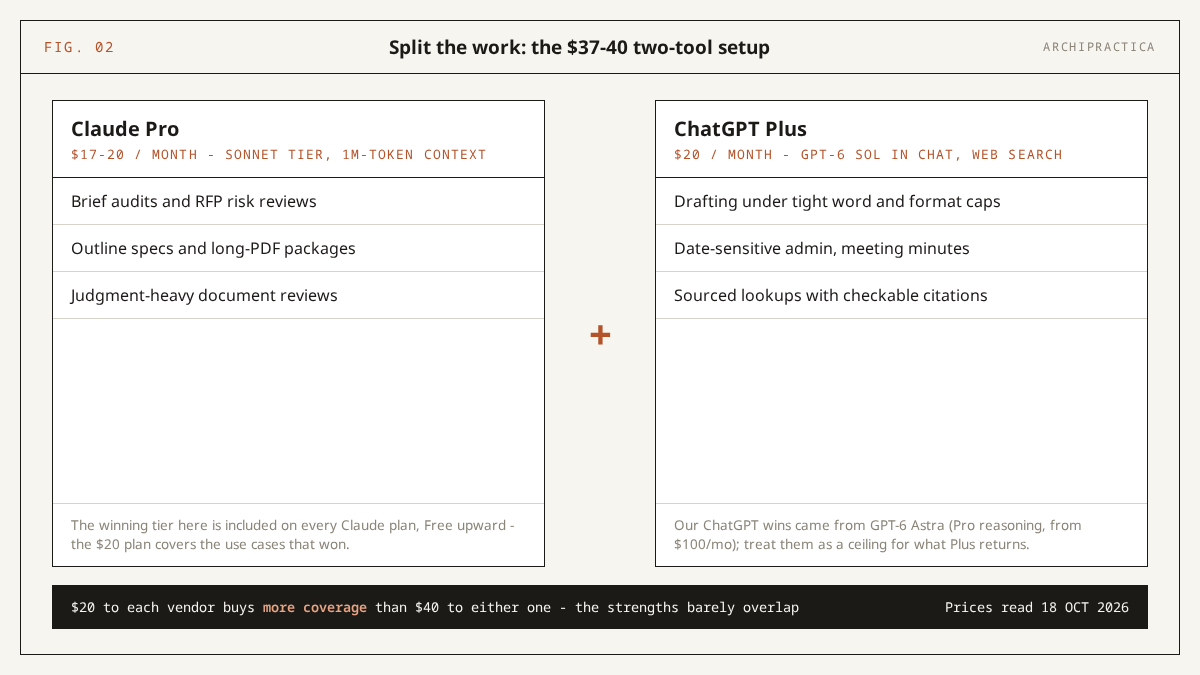
Compare the plans with the test results and a pattern emerges. The tasks Claude won are long-document tasks that fit inside its 1M-token window even on the $20 Pro plan. The tasks ChatGPT won came from its Astra reasoning tier, which in the chat app starts at Pro, $100/month; on a $20 Plus plan you get GPT-6 Sol, which we did not test. Paying $20 to each vendor buys more coverage than paying $40 to either one.
What you can do for free
You can run your own Claude vs ChatGPT for architects evaluation without paying, and for light document work the free tiers hold up for weeks. Claude’s Free plan includes the same Sonnet-tier model we tested, with web search and 5 Projects. ChatGPT’s Free plan gives unlimited text chat on GPT-6 Luna, a lighter model than the Sol and Astra tiers, with three file uploads a day and ads in several markets.
| Tool | Free tier | Real limit | Enough for |
|---|---|---|---|
| Claude Free | Sonnet + Haiku, web search, Artifacts, 5 Projects | Usage caps reached quickly in long document sessions | Evaluating on one live brief; occasional reviews |
| ChatGPT Free | GPT-6 Luna, unlimited text chat | 3 file uploads/day; ads; lighter model than paid tiers | Drafting emails and minutes; quick questions |
Checked against both vendors’ pricing pages, 18 October 2026.
The practical free-tier split: use Claude Free for anything built on an uploaded document, since the model tier matches the paid option and the constraint is volume. Use ChatGPT Free for text-only drafting where upload caps are not an issue. Turn the training toggle off in both before pasting anything client-related. When you hit a usage limit twice in a week and it interrupts real work, that is the signal to upgrade.
Where both tools will hurt you
Both tools share the failures that matter most, especially giving wrong answers to checkable questions with full confidence. Our task 4 result - a correct value under an outdated section number - is the mild version. A Swiss firm that trains architecture practices in AI compared both tools on standards questions (September 2026) and put it plainly: “Both assistants deliver that answer, convincingly phrased, and sometimes the clause number is invented.”
Adoption data says the profession is leaning in anyway. The RIBA AI Report 2026 (July 2026, 1,100+ respondents) found 74% of UK practices using AI on at least some projects, up from 59% a year earlier, with 40% of AI-using practices applying it to standards and compliance checking - the exact category where both our test and the community threads show the thinnest ice. In the US, an AIA study (March 2025) found only 6% of architects using AI regularly and 90% concerned about inaccuracy. Among large studios, a Dezeen survey of 26 big-name practices (August 2026) found Claude the most-adopted tool at 44%, with ChatGPT and Copilot at 24% each.
Four risks to manage on day one, whichever tool you pick:
- Training defaults. Both vendors train on consumer-plan conversations unless you opt out; Anthropic’s consumer terms (August 2025) set 5-year retention when training is on, and OpenAI’s data controls work the same way via a settings toggle. Team and Business plans exclude training by default. Flip the toggle before the first client document goes in.
- Accountability stays with you. The AIA’s responsible-AI guidance (updated October 2025) states it directly: “Architects remain accountable for all work products, decisions, and representations made to clients, agencies, and the public - including work produced with AI assistance.”
- Usage limits land mid-task. Claude’s paid plans run 5-hour sessions plus weekly caps, shared across its apps, per Anthropic’s help center; heavy Pro users report hitting weekly limits by mid-week. Plan long reviews so a reset does not split your context.
- Product churn eats workflows. Canvas folded into chat, the DALL-E GPT retired, custom GPTs retire in December, GPT-5.5 left with a month’s notice. Keep your prompts in your own files - a library like our 50-prompt collection ports between tools; a custom GPT does not.
FAQ
Which is better for architects, Claude or ChatGPT?
Neither wins outright. In our 12-task Claude vs ChatGPT for architects test (18 October 2026), Claude produced deeper work on brief audits, RFP risk reviews and outline specs; ChatGPT (GPT-6 Astra) was more reliable on word limits, dates and code-section citations; six tasks tied. Pick by your dominant task type - long documents favour Claude, format discipline and sourced lookups favour ChatGPT - or run both free tiers for two weeks.
Can Claude or ChatGPT check building code compliance?
No. Both models returned correct egress values in our test, and Claude still cited a superseded section number. Both carry June 2026 knowledge cutoffs and know nothing of your local amendments, so use them to locate relevant sections and draft questions, then verify every citation in the currently adopted edition yourself. Responsibility for code compliance stays with the licensed professional - the AIA’s guidance says exactly that.
Is one of them safer for confidential client documents?
They are equivalent on paper. Both train on consumer-plan chats unless you opt out, and both exclude business-plan data from training by default. The safer setup is procedural: turn the training toggle off on day one, prefer Team or Business plans for client work, and keep anything under an NDA out of consumer accounts entirely, per the AIA’s upload guidance.
Do I need the expensive plans to get these results?
Partly. The Claude results came from the Sonnet tier, which every Claude plan includes, starting with Free - so the $17 to $20 Pro plan covers the use cases that won here. The ChatGPT results came from GPT-6 Astra, which chat users get through Pro reasoning from $100/month; the $20 Plus plan runs GPT-6 Sol, which we did not test and may differ.
Should a small practice pay for both?
If both free tiers keep interrupting real work, yes - the $37 to $40 monthly combination of Claude Pro plus ChatGPT Plus buys more coverage than $100 to either vendor alone, because the strengths barely overlap. Our test suggests the split: Claude for brief, RFP, spec and long-PDF work; ChatGPT for drafting under tight formats, date-sensitive admin and sourced lookups.
Sources
- Anthropic - Claude pricing (read 18 October 2026)
- Anthropic - Models overview (read 18 October 2026)
- OpenAI - ChatGPT pricing (read 18 October 2026)
- OpenAI - GPT-6 and Intelligent UI for everyone (7 October 2026)
- RIBA - AI Report 2026 (22 July 2026)
- AIA - Guidance for the Responsible Use of AI (updated 22 October 2025)
- Dezeen - Big-name studios encouraging architects to use AI (25 August 2026)
- ICC - 2021 IBC Section 1020.3 (read 18 October 2026)
- hierarchy.ch - ChatGPT or Claude for Architects? (8 September 2026)
If one row of that Claude vs ChatGPT for architects table saves you from choosing the wrong subscription or having a submission rejected at plan check, the newsletter brings a tested workflow like this every week. One workflow, one tool, no hype. Subscribe.