T–03Tool test
Best Free AI Tools for Architects: What You Get in 2026
On this page
TL;DR: The free AI tools for architects that cost $0 and run on no trial clock are the general assistants (ChatGPT Free, Claude Free and Gemini) plus NotebookLM for questions about your own uploaded sources; specialist design tools mostly hand out one-time welcome credits or ship free plans that exclude the AI. The permanent free tiers that do include generation (Gendo, Visoid, D5 Render Community) pay for it with watermarks, 1k resolution caps or a non-commercial license.
A word on scope before the lists. On 22 and 23 October 2026 we tested the text assistants ourselves: three architect tasks, four models, run programmatically from a command-line client, one run per task per model. The render and floor-plan free tiers in this roundup of free AI tools for architects are feature comparisons from vendor documentation captured 22 October 2026. We generated no renders and no floor plans.
Free tiers matter because most practices start without a budget line for AI. According to the RIBA AI Report 2026 (July 2026), 74% of UK practices now use AI at least sometimes on current projects. If your practice is among them, or about to be, a free tier is the likely starting point, and its refresh rules matter more than its headline features.
What does free actually mean in AI tools?
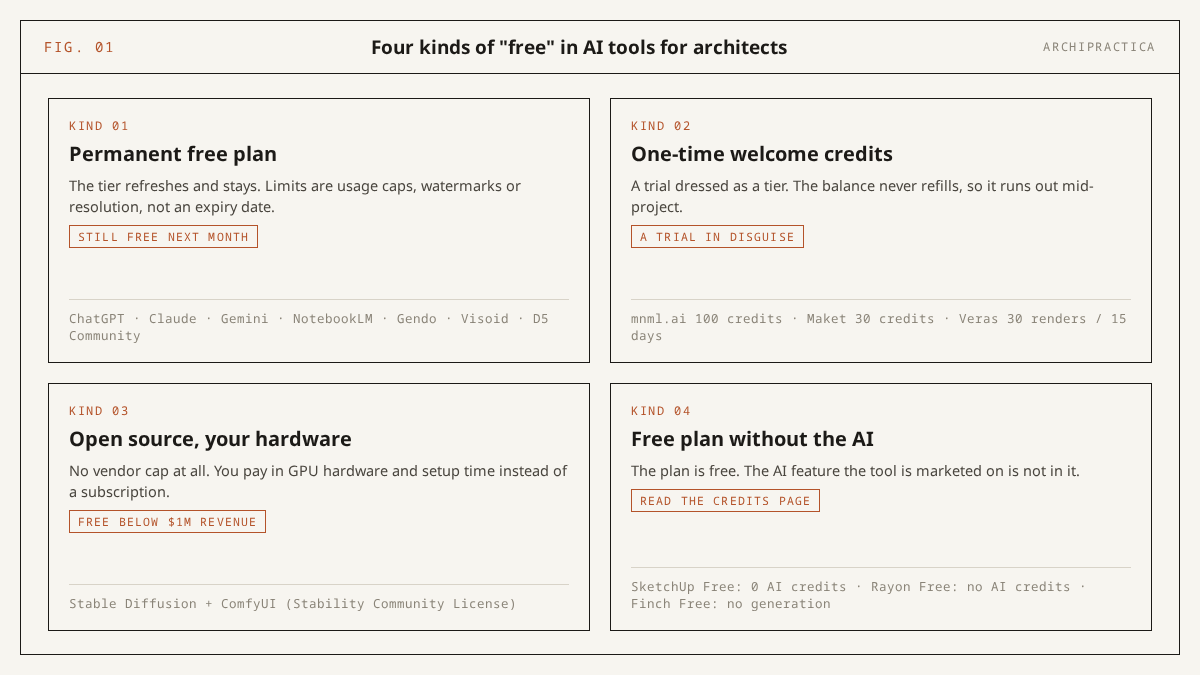
Free covers four different arrangements, and the type determines whether a tool is still free next month. Permanent free plans renew on their own, welcome credits are one-time trials, open-source models are free once you own the hardware, and some free plans carry an AI brand while excluding the AI itself. Sorting the tools into these four bins is the first filter we apply.
The first kind is the permanent free plan. ChatGPT Free, Claude Free, Gemini without a plan and NotebookLM renew at $0, and on the design side Gendo Free, Visoid Free and D5 Render Community are listed as free plans with no trial clock on their pricing pages, all captured 22 October 2026. The price is paid in usage limits on the assistants and in watermarks, export caps or license clauses on the renderers.
The second kind is the one-time welcome credit, which is a trial in disguise. mnml.ai gives 100 credits on signup, Maket gives 30, and Veras gives 30 renders inside 15 days, per each vendor’s page on 22 October 2026. The mnml and Maket balances are one-time signup credits, and the Veras clock stops after 15 days. The balance runs out mid-project, and the pricing page is what you see next.
The third kind is open source on your own hardware. Stable Diffusion under the Stability Community License, run through ComfyUI, costs nothing per image and never expires. The cost moves to the GPU in your workstation and the evenings spent learning the ComfyUI workflow. For a practice with one capable machine this is the only free option with no cap at all.
The fourth kind is the free plan that excludes the AI feature the tool is known for. SketchUp Free ships zero AI credits per SketchUp’s AI-credits page, Rayon Free has no AI credits, and Finch Free has no generation, per their help and pricing pages on 22 October 2026. The free plan exists; the AI from the launch video sits behind a paid tier.
Can free AI assistants handle real architect work?
On the three tasks we ran on 22 and 23 October 2026, yes, within limits. All four models turned a client thread into a usable brief, built a zoning table without inventing a setback, and wrote a delay email that kept every fact. One of the four added a currency symbol the thread never gave. The discipline came from the prompt; a licensed professional verifies any zoning table against the current local code edition.
We ran three tasks through four models, one run each: Claude Sonnet 5 and GPT-6 Astra on 22 October 2026, GPT-5.6 Luna and Gemini 4 Argon on 23 October 2026. Every model received the same three inputs verbatim. Task one was a messy three-message client thread, written as a fictional fixture for the test, to turn into a project brief. Task two was to check draft design parameters against a fictional zoning excerpt and record the results in a compliance table. Task three was a schedule-delay email to a client.
The Claude side ran Claude Sonnet 5, from the Sonnet family that Claude’s Free plan includes per the claude.com pricing matrix, checked 22 October 2026. The GPT side ran two models: GPT-6 Astra, the model OpenAI ties to its Pro tier, and GPT-5.6 Luna, which OpenAI’s Help Center names for ChatGPT Free. That makes the Luna run the closest in this test to what a free ChatGPT account gets.
The Gemini side needs a caveat. Per Google’s model-access page, captured 23 October 2026, accounts without a plan run on Auto, which sends most prompts to Flash-Lite and some to Flash or Pro. We ran Gemini 4 Argon, which Google lists on AI Pro and Ultra, because our command-line client offered no Flash-Lite model. Do not read the Gemini result as what a free account gets. None of the 12 runs went through a free chat account, so the results show what the models can do; how far a free account’s daily limits stretch was outside the test.
On the brief, all four models kept the clients’ contradictory size targets (160 m2 versus 190 to 200 m2) open as a question for the clients, and none picked one. All four carried an unconfirmed drainage easement into the open questions as unresolved. Claude Sonnet 5, GPT-6 Astra and Gemini 4 Argon flagged a skylight the thread mentions as “discussed” but never discusses; Gemini quoted the line and noted that the discussion sits outside the thread. Luna called the skylight previously discussed without that flag, and it made the one clear mistake of the test: it wrote the budget as “£420,000” although the thread names no currency, then added a note that the symbol was a formatting assumption to confirm. The other three wrote that the currency is not stated. The numbers of open questions were 9 (Claude Sonnet 5), 10 (GPT-6 Astra), 16 (Luna) and 7 (Gemini 4 Argon).
On the zoning table, all four quoted the excerpt verbatim, named the 10.1 m ridge against the 9.5 m cap as the urgent issue, and wrote “cannot tell from the pasted text” for the rear setback, because the prompt ordered exactly that. The garage split them. GPT-6 Astra and Gemini 4 Argon asked whether the existing garage footprint counts toward site coverage and marked the whole-site figure “cannot tell”. Claude Sonnet 5 and Luna computed coverage from the house footprint alone (31.9% and 31.94%), did not raise the garage, and both marked coverage “Yes”. All four delay emails stayed under 200 words and kept all six facts.
These are single runs on fictional fixtures and carry no statistical weight. All four models wrote “cannot tell” where the prompt demanded it. We did not test what any of them does without that instruction, which is why the prompt carries it: nothing else in the task stops a model from filling the gap with a figure from another jurisdiction or an older code edition. A zoning conclusion from a free assistant is a starting point. A licensed professional must verify it against the current code edition in the applicable jurisdiction.
Tested: 22 and 23 October 2026, versions: Claude Sonnet 5 and GPT-6 Astra (22 October), GPT-5.6 Luna and Gemini 4 Argon (23 October), run programmatically from a command-line client, one run per task per model.
The zoning prompt we used, ready to paste:
I am an architect checking a draft design against a zoning excerpt. Below are (1) the zoning text and (2) my draft design parameters. Build a table: parameter | zoning requirement | my design | complies yes/no/cannot tell. Quote the zoning text verbatim in the requirement column. If the pasted text does not cover a parameter, write "cannot tell from the pasted text" - do not fill it from general knowledge. End with the single most urgent issue.

[paste the zoning excerpt]

[paste your draft parameters]
The 10 free tiers compared
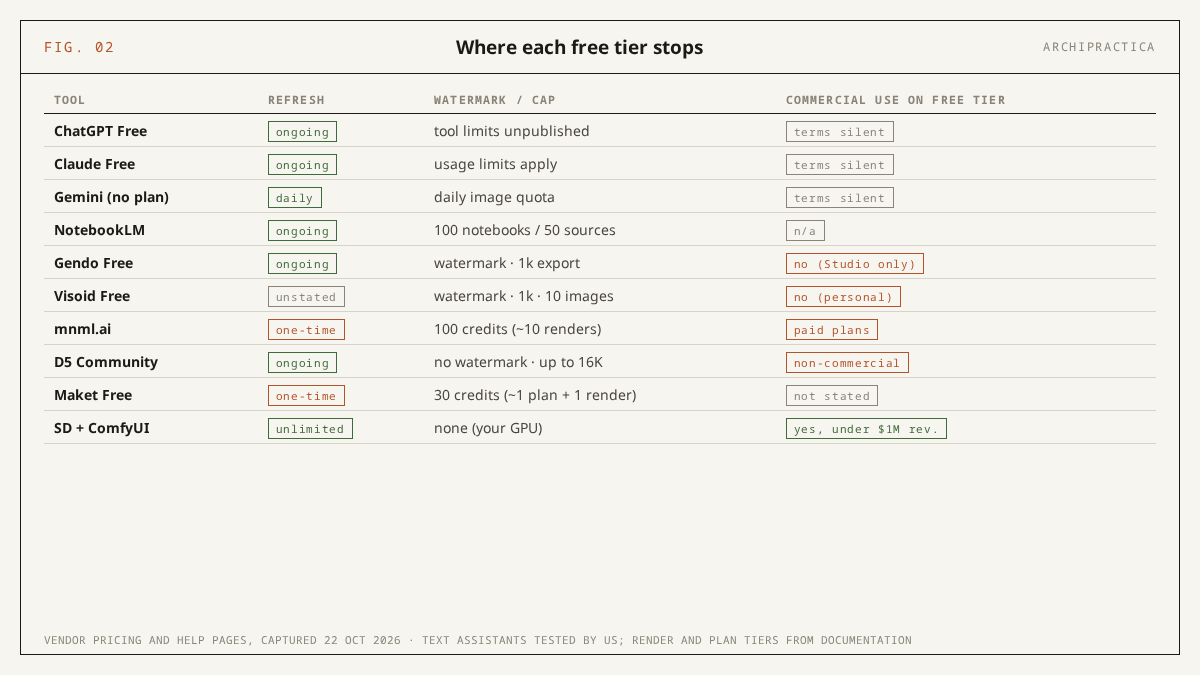
Each of the ten free tiers stops at a different ceiling. The assistants and NotebookLM renew on their own, three design tools stay free for good and pay for it with watermarks, 1k exports or a non-commercial license, two hand out one-time credits, and one runs on your own GPU with a commercial license up to $1M revenue. The table lists the ten free AI tools for architects side by side, captured 22 October 2026.
| Tool | What the free tier includes | Refresh | Watermark / cap | Commercial use on free tier |
|---|---|---|---|---|
| ChatGPT Free | GPT-5.6 Luna; unlimited everyday text chats subject to abuse-prevention safeguards; uploads, images, voice and data analysis have separate unpublished limits; ads may appear in certain countries | Ongoing | n/a (text); tool limits unpublished | Not reviewed here; data may train models unless you opt out |
| Claude Free | Sonnet and Haiku models, web search, Artifacts, up to 5 Projects | Ongoing, usage limits apply | n/a (text) | Not reviewed here; consumer chats may train models unless you opt out (Anthropic consumer-terms update, August 2025) |
| Gemini (no plan) | Auto model selection, mostly Flash-Lite per Google’s model-access page; Nano Banana 2 image generation with a daily quota | Usage limits refresh every 5 hours up to a weekly limit | AI Plus advertises 2x the Free usage and AI Pro 4x, so Free limits are real but unnumbered | Not reviewed here |
| NotebookLM | 100 notebooks, 50 sources per notebook | Ongoing, limits “subject to change” | n/a | n/a (works on your own uploaded sources) |
| Gendo Free | Unlimited generations, 1 active canvas, 50 assets per canvas | Ongoing | Gendo watermark, 1k export, 10-image-set history | Not listed on Free; “Commercial license (client and NDA-safe)” appears on paid Studio |
| Visoid Free | Up to 10 standard-resolution 1k images | Refresh period not stated on the page | Visoid watermark, 1k | No - personal license |
| mnml.ai | 100 welcome credits (about 10 fast renders by mnml’s own credit arithmetic); plugins free to install | One-time | None mentioned for the trial credits | Commercial license is a paid-plan feature |
| D5 Render Community | Desktop real-time renderer, images up to 16K, 50 AI trial credits | Ongoing (AI credits: 50 trial) | No watermark mentioned on the pricing page | No - “designed for non-commercial purposes” per D5’s FAQ; needs Windows and a ray-tracing GPU |
| Maket Free | 30 one-time credits - one floor plan plus one render, by Maket’s own credit prices | One-time | None stated | Not stated for free credits |
| Stable Diffusion + ComfyUI | The full model on your own GPU | Unlimited | n/a (local model) | Yes - Stability Community License allows commercial use under $1M annual revenue |
Feature comparison from vendor pricing and help pages, captured 22 October 2026. We tested only the text assistants ourselves; we generated no renders or floor plans.
What can you render for free?
Enough for internal studies and rarely enough for a client board. Gendo Free gives unlimited watermarked 1k images, Visoid Free gives ten, mnml.ai gives about ten through welcome credits, and D5 Render Community renders without a stated watermark under a non-commercial license, with Veras a 15-day trial. Every figure here comes from vendor pages captured 22 October 2026, and we generated no renders ourselves.
Gendo Free is the most generous permanent tier on paper: unlimited generations, one active canvas, 50 assets per canvas, per gendo.ai pricing. Every export carries the Gendo watermark and stops at 1k, and history keeps only the last 10 image sets. That is fine for internal mood studies. A client board needs a commercial license, which Gendo lists on paid Studio as “Commercial license (client and NDA-safe)”.
Visoid Free gives up to 10 standard-resolution 1k images with a Visoid watermark under a personal license, per visoid.com. The page does not state whether or when the 10 refresh. Ten images is enough to judge whether the Visoid style suits your work. It is no more than that.
mnml.ai hands new accounts 100 welcome credits, which by mnml’s own credit arithmetic on its pricing page comes to about 10 fast renders, and then the paid plans begin. The plugins for SketchUp, Revit, Rhino and Grasshopper are free to install.
D5 Render Community is a desktop real-time renderer. Images go up to 16K, no watermark is mentioned on the d5render.com pricing page, and 50 AI trial credits come with it. D5 requires Windows and a ray-tracing GPU, per its system-requirements page, checked 20 October 2026. The limit sits in the license text. D5’s FAQ states: “Any commercial, revenue-generating, or professional work requires a D5 Pro license.”
Veras offers a trial of 30 renders inside 15 days, per EvolveLab’s page. EvolveLab’s page lists only the trial, with no permanent free plan on it. Chaos, which bought EvolveLab in February 2025, markets Veras on its own page with 4 free trial scenes, so the free allowance may differ between the two pages.
At client-board volume no free tier gets you there. The permanent tiers either watermark the output or cap it at 1k, and D5 Community, which mentions no watermark, is non-commercial by license.
What about floor plans and early design?
Less than the marketing suggests. Maket Free gives 30 one-time credits, enough for one floor plan plus one render; Rayon Free is a working design workspace with full editing and zero AI credits; Finch Free offers editing and live metrics with no generation, all per their pricing and docs pages captured 22 October 2026. Plan to pay before any AI layout tool earns a place in your workflow.
Maket Free gives 30 one-time credits. By Maket’s own credit prices, a generated floor costs 20 credits, an optimization 5 and a render 10, so the free balance buys one floor plus one render, or one floor plus two tweaks. Maket’s own blog is candid about what comes out: “AI-generated floor plans are excellent for exploration and planning conversations, but they are not construction documents. A licensed architect or structural engineer needs to review any layout before permitting or building.” (Maket blog, March 2026).
Rayon Free is a working design workspace with full editing, unlimited public models and limited PDF and DWG export. Rayon Free carries zero AI credits. AI starts at Pro, 100 credits per week at EUR 19 per month billed yearly.
Finch Free includes editing plus live performance metrics and no generation. Finch’s docs FAQ says AI unit plan generation is “currently only available for our strategic AI customers”. AI unit plan generation is limited to those customers. The unit-mix and circulation generation Finch sells starts at Basic (EUR 79 per month), and the free plan is an editor. For how practices actually fit these tools into early design, see our survey roundup of how architects actually use AI.
Where free hides the catch
The catch sits below the pricing page headline, in the refresh rule, the watermark, the export resolution, the license clause and the model name behind the tier. Six checks, each under a minute on the vendor’s own page, separate a tier you can plan around from one that stops the week a deadline lands.
- Refresh. One-time credits end mid-project. mnml.ai, Maket and Veras all give a single balance with no refresh, so the last credit is the last render.
- Watermark. It surfaces at presentation time. Gendo Free and Visoid Free both stamp every export, and you notice the stamp when the image is already on the board.
- Resolution. 1k is screen-only. Gendo and Visoid cap free exports at 1k; at 300 dpi a 1,024 px edge prints at under 9 cm.
- Commercial license. D5 Community mentions no watermark and is still non-commercial by its FAQ. Stability’s Community License flips to a paid enterprise license at $1M annual revenue.
- The model behind the tier. On the free AI tools for architects that chat, the free tier and the paid tiers run different models. Free ChatGPT runs GPT-5.6 Luna, which we tested; GPT-6 Astra, which we also ran, sits on the Pro tier. Gemini without a plan runs Auto, mostly Flash-Lite, while Gemini 4 Argon, the model we ran, sits on AI Pro and Ultra. Claude Free runs Sonnet and Haiku while Fable and Opus sit on paid plans. Sources: OpenAI’s Help Center and claude.com pricing, 22 October 2026; Google’s model-access and subscriptions pages, 23 October 2026.
- The free plan without the AI. SketchUp’s free plan includes no AI credits at all. AI Render costs 10 credits per generation, and credits start with paid Go at 100 per month, per SketchUp’s help pages. Rayon Free has no AI credits and Finch Free has no generation. Read the credits page before planning a workflow around a logo that says AI.
Can you use free-tier output for client work?
Often not, and the block is a license clause. The free AI tools for architects covered here mostly carry personal or non-commercial licenses on their render tiers, consumer assistants may train on what you paste, and whatever the license allows, zoning and code answers remain drafts until a licensed professional verifies them. Run three checks before any free-tier output reaches a client file - license, data controls, verification.
- License. Visoid Free is a personal license, D5 Community is non-commercial, and Gendo lists its commercial license on paid Studio, per each vendor’s page on 22 October 2026. Stable Diffusion is the exception: the Stability Community License allows commercial use below $1M annual revenue. We did not review the consumer output-use terms of ChatGPT, Claude or Gemini for this article; read them before relying on them.
- Data controls. Anthropic’s consumer terms, updated August 2025, use chats for model training unless you opt out, and ChatGPT’s consumer plans train on content by default until you disable “Improve the model for everyone” in Data controls, checked 20 October 2026. OpenAI’s Help Center also says ads may appear in the Free tier in certain countries. Do not paste confidential client material into any consumer free tier without checking the settings. We cover them in Claude for architects and compare the assistants in Claude vs ChatGPT for architects.
- Verification. Whatever the license says, zoning, code and structural conclusions from AI remain drafts. In our runs all four models wrote “cannot tell” where the prompt demanded it, and we did not test them without that instruction, so keep it in every zoning or code prompt. A licensed professional must verify every such conclusion against the current code edition in the applicable jurisdiction.
FAQ
Is ChatGPT free for architects?
Yes, ChatGPT Free gives unlimited everyday text chats on GPT-5.6 Luna, subject to abuse-prevention safeguards, per OpenAI’s Help Center in October 2026. Uploads, images, voice and data analysis carry separate limits whose numbers OpenAI does not publish, and ads may appear in certain countries. The free tier’s GPT-5.6 Luna is the model we ran on our three tasks on 23 October 2026, one run each; its one slip was an invented currency symbol.
What is the best free AI tool for architectural renders?
It depends on which wall you hit first. Gendo Free gives unlimited watermarked 1k drafts for internal studies. D5 Render Community mentions no watermark and renders up to 16K, and its license is written for non-commercial purposes such as learning, personal projects and evaluation. Nothing free covers client-deliverable volume, per vendor documentation captured 22 October 2026. Pick by the wall you can live with, and budget for a paid tier before the first client board.
Can I use free AI renders commercially?
Usually no, so read the license. Visoid Free is a personal license, D5 Community is non-commercial by its FAQ, and Gendo lists its commercial license on paid Studio, per each vendor’s page on 22 October 2026. Stable Diffusion is the exception: the Stability Community License allows commercial use for individuals and organizations under $1M annual revenue. mnml.ai lists the commercial license as a paid-plan feature.
Do free AI tools train on my data?
Consumer assistants may. Anthropic’s consumer terms, updated August 2025, use chats for training unless you opt out, and ChatGPT’s consumer plans train on content by default until you disable “Improve the model for everyone” in the data controls. Check those settings before pasting client material, and treat anything confidential as off limits on a consumer plan. Before upgrading, check the training terms of the business plan you choose; we did not review them here.
Sources
- OpenAI Help Center - ChatGPT Free tier FAQ - GPT-5.6 Luna on Free, unlimited everyday chats with safeguards, unpublished tool limits, ads in certain countries; captured 22 October 2026.
- OpenAI Help Center - Data controls - consumer plans train on content by default, opt-out toggle; checked 20 October 2026.
- claude.com pricing - Claude Free models (Sonnet and Haiku), web search, Artifacts, 5 Projects, usage limits; captured 22 October 2026.
- Anthropic - updates to consumer terms - consumer chats used for training unless opted out; announced August 2025, checked 16 October 2026.
- Google support - Gemini image generation - Nano Banana 2 daily quota on the no-plan tier; captured 22 October 2026.
- Google support - Changes to Gemini model access and limits - no-plan accounts on Auto, most prompts to Flash-Lite; Plus 2x and Pro 4x standard limits; captured 23 October 2026.
- Google - Gemini subscriptions - AI Plus advertises 2x and AI Pro 4x the Free tier’s usage; Gemini 4 Argon on AI Pro and Ultra; captured 22 and 23 October 2026.
- Google support - NotebookLM plans - 100 notebooks and 50 sources per notebook, limits subject to change; captured 22 October 2026.
- gendo.ai pricing - Free tier unlimited generations, 1 canvas, 50 assets, watermark, 1k export; “Commercial license (client and NDA-safe)” on Studio; captured 22 October 2026.
- visoid.com - Free tier 10 images at 1k, watermark, personal license; captured 22 October 2026.
- mnml.ai pricing - 100 welcome credits, credit arithmetic, free plugins, commercial license on paid plans; captured 22 October 2026.
- d5render.com pricing - Community edition features, 16K output, 50 AI trial credits, non-commercial FAQ wording; captured 22 October 2026.
- d5render.com system requirements - Windows and ray-tracing GPU requirement; checked 20 October 2026.
- EvolveLab - Veras - 30 renders and 15-day free trial; captured 22 October 2026.
- Chaos - Veras - Chaos page marketing a Veras trial with 4 free scenes; captured 22 October 2026.
- Chaos press release - Chaos acquires EvolveLab - acquisition announced February 2025; checked 17 October 2026.
- maket.ai pricing - 30 free credits and per-action credit prices (20 per floor, 5 per optimization, 10 per render); captured 22 October 2026.
- Maket blog - How AI helps in building design - “not construction documents” caveat; published March 2026, captured 22 October 2026.
- ComfyUI on GitHub - open-source interface for Stable Diffusion, runs on Windows, macOS and Linux; captured 22 October 2026.
- rayon.design pricing - Free workspace scope, zero AI credits on Free, Pro at 100 credits per week and EUR 19 per month billed yearly; captured 22 October 2026.
- finch3d.com get-started - Free plan editing and live metrics, generation starts on paid Basic; captured 22 October 2026.
- Finch docs FAQ - “AI Unit plan generation is currently only available for our strategic AI customers”; captured 22 October 2026.
- help.sketchup.com - AI credits - zero AI credits on SketchUp Free, 10 credits per AI Render, 100 per month from Go; captured 22 October 2026.
- stability.ai license - Stability Community License, commercial use under $1M annual revenue; captured 22 October 2026.
- RIBA Artificial Intelligence Report 2026 (PDF) - 74% of UK practices using AI at least sometimes on current projects, July 2026; captured 22 October 2026.
Next step: open the pricing page of one tool you already have an account on, run the six checks from the catch section, and note which wall you hit first. That tells you whether its free tier is a plan or a trial.
If this saved you a trial signup or two, the newsletter brings one tested workflow and one tool every week, with dates and limits stated. Subscribe.