G–12Guide
How Will AI Change Architecture? Shipped vs Forecast to 2030
On this page
- What is AI changing in architecture right now?
- What vendors have shipped and what they have only announced
- What do forecasts say about architecture to 2030?
- Change by project stage: evidence today, forecast and what to do
- How will AI affect fees and practice economics?
- The regulatory and professional calendar to 2028
- What can the forecasts not tell you?
- How to prepare a practice for 2027
- FAQ
- Sources
How will AI change architecture between now and 2030? The evidence to date shows uneven, task-level change: in RIBA’s 2026 survey 74% of surveyed practices use AI on at least some projects and only 15% have it embedded day to day, while Autodesk now ships Autodesk Assistant inside Revit 2027, introduced as a Tech Preview. Forecasts from McKinsey (July 2026), Deloitte (November 2025) and RIBA respondents (2026) point to agentic workflows (software that carries out a sequence of tasks with limited human input), reuse of project data and pressure on hourly fees; they are projections, and accountability stays with the architect.
We compiled shipped vendor documentation, EU law and published surveys and forecasts, read or re-checked between 2 and 5 November 2026. We ran no survey, built no forecast and tested no tool; every forecast is labelled with who made it and when. For the survey figures side by side, see our comparison of seven surveys.
What is AI changing in architecture right now?
AI use is widespread; day-to-day integration remains limited. In the RIBA AI Report 2026 (survey March-April 2026, over 1,100 self-selecting responses, published July 2026), 74% of surveyed practices use AI on at least some projects, up from 41% in 2024 and 59% in 2025. 31% use AI on every or most projects. Only 15% say AI is embedded in their day-to-day work; 17% are formally trialling it and 62% are starting to explore.
The uses are narrow. Among AI-using practices in the same RIBA survey, around 56% use AI for early-stage design visualisation, 40% for compliance checking and 32% for general practice management such as drafting reports. 24% use it for specification writing or technical design, and up to 10% for BIM, performance simulation or environmental impact modelling.
The Chaos and Architizer report (online survey November 2025, nearly 800 respondents invited from Architizer members, Chaos users and the wider AEC community) shows a similar profile among its AI users: image generation from model inputs 40%, from text prompts 40%, building code analysis 13%, layout or plan generation 8%. In the same survey, 20% of respondents said their firm is fully embracing AI, 38% at firms with over 100 employees against 17% at firms of five or fewer.
Evidence of return is thinner than evidence of use. Deltek’s Clarity A&E study (press release 12 May 2026, 896 architecture and engineering firms in the US and Canada) reports AI adoption up from 53% to 70% year over year, while only 38% of those A&E firms report a measurable positive business impact tied to AI. Bluebeam’s 2027 AEC Technology Outlook (press release 13 October 2026, a July 2026 survey of 750 US AEC technology decision-makers) found 28% had moved AI into production, meaning live use on real work beyond pilots, and 7% had it embedded across multiple core workflows.
Training also lags. In the AIA/Deltek Architecture Billings Index for August 2026 (published 23 September 2026), 48% of responding firm leaders were engaging with AI, while just 7% of responding firms have a formal AI training program. Read together, these surveys describe AI in architecture as a layer on top of existing work, concentrated in early design images, code and specification lookups, and drafting text for reports and project documentation.
What vendors have shipped and what they have only announced
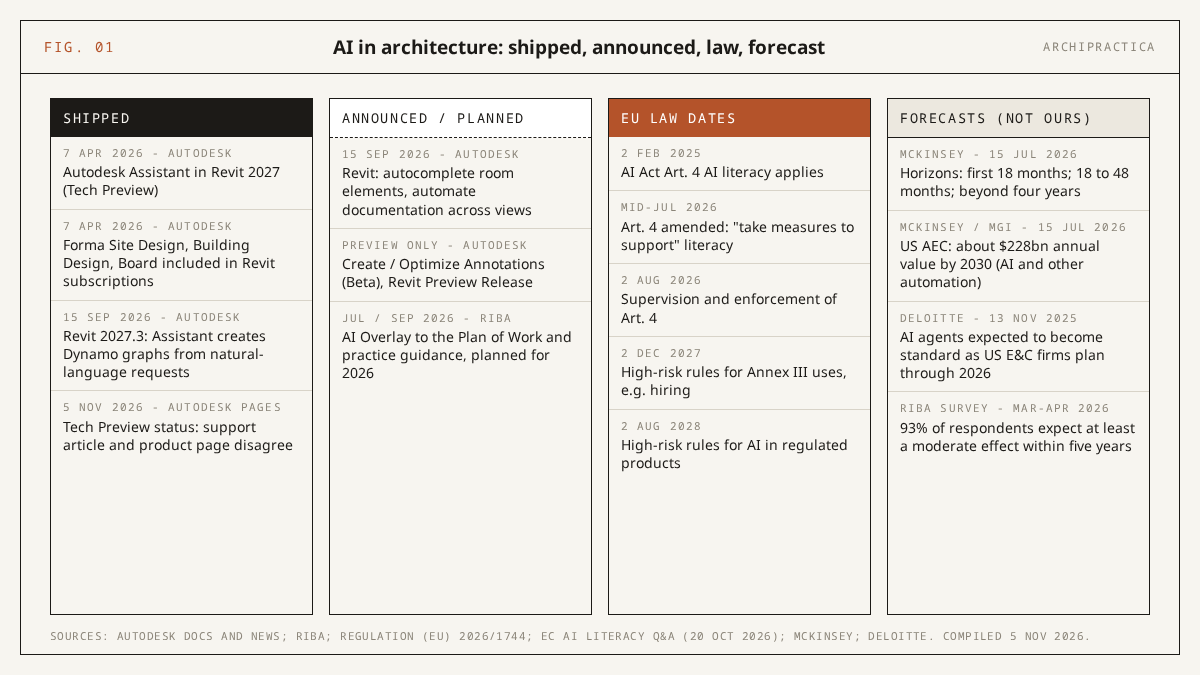
Autodesk ships AI inside core architecture software. Autodesk Assistant arrived in Revit 2027 in April 2026 as a Tech Preview (Autodesk’s label for an early-access release) and, since Revit 2027.3 on 15 September 2026, can create and modify Dynamo graphs from natural-language requests. The Revit workflows Autodesk presented on 15 September 2026 (autocomplete room elements, optimize annotations, automate documentation) are announcements, and the annotation features exist only as Beta in the Revit Preview Release.
| Item | Status, 2-5 Nov 2026 | Source and date |
|---|---|---|
| Autodesk Assistant in Revit 2027 | Shipped in Revit 2027, introduced as Tech Preview; capability areas: Product Help, Model Queries, Task Automation (“Create a door schedule”) | Revit 2027 release blog, 7 Apr 2026; Revit 2027 help, read 2 Nov 2026; Autodesk support article on enabling the Assistant, 5 Nov 2026 |
| Assistant creating and modifying Dynamo graphs from natural-language requests | Shipped with Revit 2027.3 and Dynamo 4.2.x; released 15 Sep 2026 | Revit 2027.3 release notes; Autodesk support article on Dynamo graphs, read 5 Nov 2026 |
| Assistant’s Tech Preview status | Autodesk pages disagree: the Dynamo support article says the Assistant “has exited Tech Preview”; the Revit product page says “Now available in tech preview” | Both read 5 Nov 2026 |
| Forma Site Design, Building Design, Board, Data Management Essentials | “Now included in Revit subscriptions” | Revit 2027 release blog, 7 Apr 2026 |
| Create Annotations and Optimize Annotations | Beta; “currently available only in the Revit Preview Release for testing” | Autodesk AI transparency cards page, read 2 Nov 2026 |
| Autocomplete room elements; automate documentation across multiple views | Announced, with architects “reviewing and accepting the results”; not in a general release on Autodesk’s pages we read | Autodesk News, 15 Sep 2026 |
Vendor documentation and announcements read 2-5 November 2026. Not a test: we did not run Revit for this article.
Autodesk’s transparency card for the Assistant (PDF dated 14 September 2026, read 2 November 2026) lists three known limitations: “May produce inaccurate results”, “Dependent on input quality” and “Not for safety-critical use”. The Dynamo support article (read 5 November 2026) adds that AI-generated workflows should be “reviewed and validated before being used in production”.
Autodesk’s 15 September 2026 post also states a direction: “Over time, more of the design, analysis, coordination, and documentation work architects do in Revit today will happen directly in Forma.” Autodesk gives no date for that shift. For a general chat assistant connected to Revit in the meantime, see our guide on connecting Claude to Revit.
What do forecasts say about architecture to 2030?
Three sources address the question “How will AI change architecture?” to 2030, each using a different unit. McKinsey (15 July 2026) estimates automation potential and sets three horizons for AEC; Deloitte (13 November 2025) expects AI agents to become standard as US engineering and construction firms plan digital initiatives through 2026. RIBA’s survey (March-April 2026) records what UK practices expect: 93% see at least a moderate effect within five years.
McKinsey (July 2026)
McKinsey’s article How AI is reshaping the future of the AEC industry (15 July 2026) states: “AI is unlikely to be an extinction event for AEC firms, but it could meaningfully change who leads the industry.” Its headline estimate (15 July 2026) is that “AI has the potential to automate 50 percent of nonphysical work in the architecture and engineering sectors” (39 percent in construction), per a McKinsey Global Institute (MGI) analysis.
That 50 percent measures technical potential for nonphysical work across architecture and engineering together, and McKinsey (July 2026) says adoption “will take time” and that companies “will only automate work when they have a compelling business case”. McKinsey’s July 2026 article cites the MGI projection that the AEC industry “could unlock roughly $228 billion by 2030 in annual value in the United States through AI and other automation technologies”: US-only, AEC-wide, and including automation other than AI.
McKinsey (July 2026) sets three horizons counted from publication: a near term of the first 18 months spent streamlining end-to-end workflows, a medium term of 18 to 48 months built on data advantages, and a long term beyond four years focused on value on site. The near-term list in McKinsey’s July 2026 article includes bid/no-bid analysis, proposal drafting and estimating, plus design checks, specification review and code and standards interpretation; in our reading, for code and specification work that output is still a draft for a licensed professional to verify.
For the medium term, McKinsey (July 2026) writes: “Instead of treating BIM as a static file delivered at the end of a project, firms can use AI to transform it into a live, continuously updated view of the project throughout its life cycle.” McKinsey (July 2026) also holds that “domain expertise will still matter over the medium term, possibly even more than it does today”, and places large-scale robotics in construction “potentially a decade away”.
Deloitte (November 2025)
Deloitte’s 2026 Engineering and Construction Industry Outlook (13 November 2025) states: “As E&C firms plan for digital initiatives through 2026, technologies like cloud-native digital twins and AI agents are expected to become standard.” AI agents here means software that plans and runs a sequence of tasks with limited human input. The outlook covers the US engineering and construction industry as a whole and does not break out architecture.
Deloitte (November 2025) also reports that “Many firms are piloting agentic AI systems to autonomously manage complex scheduling, coordinate workflows, and mitigate risk”. The same outlook warns that “poor-quality data continues to frequently undermine the reliability of analytics and AI solutions”.
RIBA members (survey March-April 2026)
RIBA’s AI Report 2026 (survey March-April 2026, published July 2026) records expectations from a self-selecting sample of UK practices. Of respondents in that RIBA survey (March-April 2026), 93% see AI as having at least a moderate effect on architectural practice in the next five years; 45% anticipate a major impact, and a further 15% expect the effect to be “transformative”.
In the same RIBA survey (March-April 2026), among practices already using AI, 91% expect their use to increase over the next two years, 7% expect no change and 1% expect to decrease or abandon it. RIBA’s report (July 2026) adds a caution on cost: the future cost of AI systems is highly uncertain “but it is unlikely to decrease. Future ROI calculations may look different.”
Before you put a forecast into a fee proposal or a staffing plan, check its horizon and unit; that is our reading of these sources. McKinsey’s 50 percent (July 2026) measures technical automation potential of nonphysical work across architecture and engineering; on its own it is neither a job forecast nor a timeline. RIBA’s 93% (2026) is the expectation of respondents who chose to answer.
Change by project stage: evidence today, forecast and what to do
Visible changes today involve concept visualisation, compliance lookups and practice admin. McKinsey’s July 2026 horizons add bids, design and code checks and a live BIM model, and Autodesk announced documentation automation on 15 September 2026. At every stage, we recommend a logged trial with licensed review. The table is our editorial synthesis of the sources on this page as of 5 November 2026.
| Project stage | Evidence today (source, date) | Forecast (who, when) | What to do now (our recommendation) |
|---|---|---|---|
| Briefing and feasibility | 32% of AI-using practices use AI for practice management such as reports (RIBA, Mar-Apr 2026); 43% of AI users name pre-design as an area they want improved (Chaos, Nov 2025) | “Win and price the work”: bid/no-bid analysis, proposal drafting, estimating (McKinsey, Jul 2026, near term) | Trial AI on brief and site summaries; a named person checks planning and site data |
| Concept design and visualisation | Around 56% of AI-using practices use early-stage visualisation (RIBA, Mar-Apr 2026); image generation 40% from models, 40% from text (Chaos, Nov 2025) | No stage-specific forecast in the sources we read | Use for options and mood images; the design decision stays with the architect |
| Developed and technical design | 24% use AI for specification writing or technical design (RIBA, Mar-Apr 2026); Assistant builds Dynamo graphs from text (Autodesk, Sep 2026) | Design checks, specification review (McKinsey, Jul 2026, near term) | Every output is a draft; a licensed professional reviews specifications before issue |
| Code and regulatory checks | 40% use AI for compliance checking (RIBA, Mar-Apr 2026); building code analysis 13% (Chaos, Nov 2025); Autodesk card: “Not for safety-critical use” (Sep 2026) | “Code and standards interpretation” (McKinsey, Jul 2026, near term) | AI finds the sections; the licensed professional verifies against the current local code edition |
| Construction documentation | 35% of AI users name documentation as an area they want improved (Chaos, Nov 2025); documentation automation announced (Autodesk, Sep 2026); annotations Beta only (Autodesk transparency cards, read Nov 2026) | BIM as a live, continuously updated view of the project (McKinsey, Jul 2026, medium term, 18 to 48 months) | Track Revit Preview features; the architect of record checks every AI-annotated sheet before sign-off |
| Practice management, bids and fees | 7% of AI users say AI let them raise fees, 58% disagree (RIBA, Mar-Apr 2026) | Value goes to firms able to charge “for outcomes rather than hours” (McKinsey, Jul 2026) | Write down which deliverables are faster; decide time or fixed price before the next proposal |
Our editorial synthesis of the sources on this page, compiled 5 November 2026. Survey figures are self-reported, forecasts belong to the organisations named, and we ran no test.
For feasibility, our guide to AI site analysis for architects covers what current tools do with planning and site data, and for concept work there is turning a sketch into a render with AI. Technical design has drafting architectural specifications with AI, and code work has AI for building code checks.
At every stage, AI output is a draft that a licensed professional verifies against the current local code edition, and accountability stays with the architect. The AIA’s sample firm policy (AI Firm Toolkit, August 2026) warns that “AI routinely cites superseded code editions and fabricates product names and ASTM references.” The AIA guidance (last updated 22 October 2025) states that “Architects remain accountable for all work products, decisions, and representations made to clients, agencies, and the public - including work produced with AI assistance.”
How will AI affect fees and practice economics?
The evidence so far does not show higher fees. In RIBA’s 2026 survey (March-April 2026), just 7% of AI users agree that “AI has allowed our practice to increase project fees”, 58% disagree and 35% are neutral; only 13% of all respondents expect AI to allow higher fees. The AIA/Deltek Architecture Billings Index for August 2026 scored 47.2, below the 50 mark that separates growth from decline in US billings.
McKinsey (15 July 2026) writes: “AI will reduce the amount of labor hours needed in an industry that often charges clients based on time spent working. Without new commercial models, firms may give away productivity gains.” The options McKinsey names in the same July 2026 article are fixed fees, milestone payments, shared savings, risk-monitoring services and performance-linked incentives, and it expects value to go to firms that control “the ability to charge for outcomes rather than hours”.
According to the RIBA AI Report 2026, respondents plan to spend anyway: 57% agree they will invest in AI tools, 50% in AI training and 37% in AI R&D. Among AI users, 44% agree that adopting AI let them devote more time to creative, high-value work (19% disagree).
Our recommendation, informed by McKinsey’s argument and RIBA’s fee figures: before a renewal or a fee proposal, write down which stage tasks are now faster, and decide whether to price them as time or as a fixed deliverable. We make no claim that this raises fees. If you draft proposals with a chat assistant, our guide on drafting fee proposals with ChatGPT covers the structure and the checks.
The regulatory and professional calendar to 2028
For firms in the EU, the AI Act’s Article 4 duty to support AI literacy has applied since 2 February 2025, was amended in mid-July 2026 and has been enforceable since 2 August 2026. High-risk rules follow on 2 December 2027 and 2 August 2028. RIBA announced on 22 July 2026 that it plans an AI Overlay to the Plan of Work, and the AIA last updated its guidance on 22 October 2025.
| Date | What applies or is planned | Who it concerns | Source |
|---|---|---|---|
| 2 February 2025 | EU AI Act Article 4 (AI literacy) entered into application | Firms using AI in the EU | European Commission AI literacy Q&A, updated 20 Oct 2026 |
| Mid-July 2026 | Omnibus amendments to Article 4 in force; Regulation (EU) 2026/1744 of 8 July 2026 | Firms using AI in the EU | EC Q&A, 20 Oct 2026; Regulation (EU) 2026/1744, 8 Jul 2026 |
| 2 August 2026 | Supervision and enforcement of Article 4 by national market surveillance authorities; general application date of the AI Act | Firms using AI in the EU | EC Q&A, 20 Oct 2026; Regulation (EU) 2026/1744 |
| 2 December 2027 | High-risk rules apply to Annex III uses such as employment and education | Firms using AI for listed uses, for example hiring | Regulation (EU) 2026/1744; Future of Privacy Forum summary, read 5 Nov 2026 |
| 2 August 2028 | High-risk rules apply to AI in products under Annex I | Providers and deployers of AI in regulated products | Regulation (EU) 2026/1744 |
| Planned, 2026 | RIBA AI Overlay to the Plan of Work and practice guidance: “will be developed this year” (July 2026); “in the autumn” (September 2026) | UK practices using the Plan of Work | RIBA news, 22 Jul 2026; RIBA professional feature, 10 Sep 2026 |
| 22 October 2025 (last update) | AIA Guidance for the Responsible Use of AI by Architecture and Design Firms | US firms | AIA Guidance PDF, 22 Oct 2025 |
Our reading of the regulation and professional-body pages, 5 November 2026. Please check with your lawyer.
The amended Article 4, in Regulation (EU) 2026/1744 of 8 July 2026, says providers and deployers “shall take measures to support the development of AI literacy of their staff and other persons dealing with the operation and use of AI systems on their behalf”. The same article adds that the obligation “does not require providers or deployers to guarantee any specific level of AI literacy of any individual”. The European Commission’s Q&A (updated 20 October 2026) confirms that no specific or “sufficient” level is mandated, that “There is no need for a certificate. Organisations can keep an internal record of trainings”, and that staff using ChatGPT to write or translate text “should be informed about the specific risks, for example hallucination” (a fluent answer that is factually wrong, such as an invented code clause).
Our reading, which does not amount to legal advice: if your firm uses AI in the EU, the Article 4 literacy duty already applies, while the Annex III date of 2 December 2027 mainly matters if your firm uses AI for listed uses such as hiring. A written firm policy is the practical place to record the training; our guide on writing an AI policy for an architecture firm has the structure.
What can the forecasts not tell you?
The forecasts cannot tell you when a change reaches your desk, how much of your own work it touches, or whether the respondents resemble your practice. Horizons are counted from publication dates, units mix architecture with engineering and construction, and the authors are a consultancy, a professional-services firm and self-selecting survey respondents.
Authorship shapes the numbers. McKinsey’s horizons and 50 percent potential (July 2026) come from a consultancy and Deloitte’s expectations (November 2025) from a professional-services firm. The Chaos and Architizer figures (November 2025) come from a survey of Architizer members, Chaos users and the wider AEC community, and Bluebeam’s (July 2026) from a survey run for the vendor by Hanover Research. The RIBA AI Report 2026 says its respondents were self-selecting, so the results are “best read as a good indication”; our comparison of seven surveys sets out each sample.
RIBA (2026) has 74% of surveyed practices using AI on some projects and 15% with it embedded day to day; Bluebeam (October 2026) has 28% of 750 US AEC technology decision-makers with AI in production and 7% embedded across core workflows. Optimism is low: only 17% of RIBA respondents agree that AI makes them more optimistic about the future of architecture, and 49% disagree.
Our separate guide, Will AI Replace Architects?, addresses whether AI replaces architects. We use a single attitude figure here: in RIBA’s 2026 survey, 34% agree that AI will displace architects’ jobs and 45% disagree.
RIBA President Chris Williamson said on 22 July 2026: “Professional oversight of design remains essential if tomorrow’s buildings are going to be safe and sustainable.” RIBA’s report (July 2026) says: “AI is not, of course, a replacement for professional judgement and oversight.”
How to prepare a practice for 2027
Preparation for 2027 is a set of small, dated habits: one measured trial per stage, a shipped-versus-announced check at every release, a literacy record for EU firms, a pricing decision and an unchanged licensed-review step. Each provides a written record you can show a client, whatever the forecasts turn out to be. The steps below are our recommendation.
- Pick one project stage and two tasks in it. For four weeks, log minutes with and without AI, including checking time, then use that record to keep or drop each task; it is the only evidence here about your own practice. The log says little if the tasks do not recur within four weeks or come from one small job; then log across two projects or a whole stage, and treat a few data points as a hint.
- At each release, separate shipped, preview and announced features in the software you already pay for. For Revit 2027 on 5 November 2026 that means: Autodesk Assistant and Dynamo graph creation shipped (with Autodesk’s pages disagreeing on whether the Assistant is still a Tech Preview), annotation features in Beta in the Revit Preview Release, documentation automation announced on 15 September 2026.
- For firms in the EU, run a short AI-literacy session and keep an internal record of who attended and what was covered. The European Commission’s Q&A (updated 20 October 2026) says no certificate is needed; that is our reading of the Q&A, so check with your lawyer.
- Write down which deliverables are faster with AI and decide, before the next fee proposal, whether to price them as time or as a fixed deliverable. In RIBA’s 2026 survey, 58% of AI-using respondents said AI had not let them raise fees, so treat this as a pricing decision, with no fee increase implied.
- Keep the licensed-review step on codes, specifications and drawings where it is. The AIA guidance (last updated 22 October 2025) keeps accountability for all work products with the architect, including work produced with AI assistance, and requires qualified professionals to review and validate AI outputs.
- Re-read the forecasts with their units when they are updated: McKinsey’s horizons count from July 2026, RIBA’s expectations from a March-April 2026 survey. Like every year-titled article on this site, this one gets a quarterly review, and our comparison of seven surveys carries the survey figures with their samples and dates.
To answer “How will AI change architecture?” for your own practice by 2027, our recommendation is to use the log in step one: minutes saved and minutes spent checking, per task and per stage. Compare that record with the dated forecasts on this page.
FAQ
Short answers to “How will AI change architecture?” and four related questions, from the same dated sources as the page: RIBA’s 2026 survey, McKinsey’s July 2026 article, Deloitte’s November 2025 outlook, Autodesk’s Revit 2027 documentation and the EU AI Act as amended in 2026. Every forecast quoted belongs to the organisation named; none is ours.
How will AI change architecture by 2030?
None of the sources we read reports data for 2030. McKinsey (15 July 2026) sets three horizons from that date: 18 months of workflow streamlining, 18 to 48 months of building on data advantages, and value on site beyond four years. RIBA’s 2026 survey (March-April 2026) found 93% of respondents expect at least a moderate effect on practice within five years.
Which architectural tasks is AI used for most today?
In RIBA’s AI Report 2026 (survey March-April 2026, UK practices already using AI), around 56% use AI for early-stage design visualisation, 40% for compliance checking, 32% for practice management such as reports and project documentation, and 24% for specification writing or technical design. Compliance and specification output is a draft that a licensed professional verifies against the current local code edition. The Chaos and Architizer survey (November 2025) shows image generation leading.
Will AI make architecture fees go up?
The evidence so far does not show it. In RIBA’s 2026 survey (March-April 2026), 7% of AI users agree that AI has allowed their practice to increase project fees, 58% disagree, and only 13% of all respondents expect it to. McKinsey (15 July 2026) argues that without new commercial models such as fixed fees or milestone payments, firms “may give away productivity gains”. We make no claim that any pricing change raises fees.
Does the EU AI Act apply to architecture firms?
For firms using AI in the EU, yes, through Article 4. As amended by Regulation (EU) 2026/1744 of 8 July 2026, providers and deployers “shall take measures to support the development of AI literacy” of their staff. The European Commission’s Q&A (updated 20 October 2026) says no specific level is mandated and no certificate is needed. This is our reading and does not amount to legal advice.
Is AI in Revit available now?
Yes, with a caveat on status. Autodesk Assistant shipped inside Revit 2027 as a Tech Preview (release blog 7 April 2026); Autodesk’s enabling article (read 5 November 2026) says it is available only in Revit 2027. Since Revit 2027.3 (15 September 2026) it can create Dynamo graphs from natural-language requests. On 5 November 2026 one Autodesk article said it had exited Tech Preview; the Revit product page still said “Now available in tech preview”.
Sources
The documents listed below are the sources for every figure and quote on this page. Each document was captured between 20 October and 5 November 2026, and each was re-checked by 5 November 2026 as part of the preparation for this article.
- RIBA Artificial Intelligence Report 2026 (PDF) - survey March-April 2026, published July 2026
- RIBA news: AI adoption reaches tipping point across UK architecture - 22 July 2026
- RIBA professional feature: Building stronger practices for a changing profession - 10 September 2026
- McKinsey: How AI is reshaping the future of the AEC industry - 15 July 2026
- Deloitte: 2026 Engineering and Construction Industry Outlook - 13 November 2025
- Chaos and Architizer: How is AI Reshaping Architectural Design and Visualization in 2026 (PDF) - survey November 2025
- Deltek Clarity A&E industry study press release - 12 May 2026
- Bluebeam 2027 AEC Technology Outlook press release - 13 October 2026, survey July 2026
- AIA/Deltek Architecture Billings Index, August 2026 - published 23 September 2026
- AIA Guidance for the Responsible Use of AI by Architecture and Design Firms (PDF) - last updated 22 October 2025
- AIA AI Firm Toolkit, sample firm AI policies - full release August 2026
- Autodesk: What’s new in Revit 2027 - 7 April 2026
- Autodesk support: Create Dynamo graphs with Autodesk Assistant in Revit 2027.3 - read 5 November 2026
- Autodesk Revit product page - read 5 November 2026
- Revit 2027.3 release notes - release date 15 September 2026; the Revit 2027 help, the AI transparency cards page and the support article on enabling the Assistant were read on Autodesk’s help and support sites on 2 and 5 November 2026
- Autodesk Assistant transparency card (PDF) - dated 14 September 2026
- Autodesk News: Forma, AI and connected AEC workflows at AU 2026 - 15 September 2026
- Regulation (EU) 2026/1744 (Digital Omnibus on AI) - 8 July 2026
- European Commission: AI literacy questions and answers - last update 20 October 2026
- Future of Privacy Forum: The AI Act implementation timeline under the AI Omnibus - read 5 November 2026
If you take only the first preparation step, pick one stage and log two tasks for four weeks. The weekly newsletter sends a tested workflow you can time against that log.